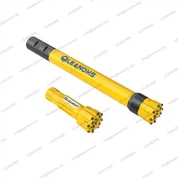
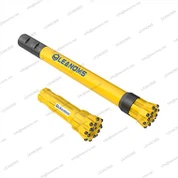
Products Description LEANOMS
Reverse circulation (RC) is a drilling technique that has been used in various industries, including mining, geothermal exploration, water well drilling, and environmental drilling. This method is particularly useful in drilling deep holes in hard rock formations, where conventional drilling techniques such as rotary drilling may not be efficient.
The process involves the use of a drilling rig that drives a dual-walled drill pipe into the ground. The drill pipe consists of an inner tube and an outer tube, with the inner tube being smaller in diameter. The drilling process begins with the rotation of the drill bit, which cuts through the rock formation. The cuttings produced by the drilling process are then transported to the surface through the annular space between the inner and outer tubes of the drill pipe.
As the cuttings reach the surface, they are collected in a cyclone separator, where the larger particles are separated from the smaller ones. The larger particles are then discharged onto the ground surface, while the smaller ones are transported to a sample collection unit for analysis. This method of drilling and sample collection allows for a more efficient and accurate analysis of the geology of the formation being drilled.
One of the main advantages of reverse circulation drilling is its ability to drill deeper and faster than conventional drilling methods. This is due to the fact that the cuttings are transported to the surface through the annular space, rather than the center of the drill pipe. This reduces the friction between the drill pipe and the rock formation, allowing the drill bit to penetrate deeper and faster.
Another advantage of reverse circulation drilling is its ability to maintain a stable borehole. This is because the cuttings are removed from the borehole as they are produced, which reduces the risk of clogging and allows for a continuous flow of drilling fluid. The continuous flow of drilling fluid helps to stabilize the borehole and prevent the formation from collapsing.
In addition, reverse circulation drilling is a more environmentally friendly method of drilling, as it produces less waste and uses less drilling fluid than conventional drilling methods. This reduces the environmental impact of the drilling process and makes it more sustainable in the long run.
In conclusion, reverse circulation drilling is a highly effective and efficient drilling technique that has revolutionized the drilling industry. Its ability to drill deeper, faster, and with greater accuracy has made it a popular choice in various industries, including mining, geothermal exploration, water well drilling, and environmental drilling. With its numerous advantages, reverse circulation drilling is likely to remain a popular drilling technique for years to come.

Specification LEANOMS

Selecting the right reverse circulation (RC) bit is essential to the success of any drilling project. There are several factors that need to be considered when choosing the right RC bit, including the type of formation being drilled, the size of the borehole, the drilling speed required, and the budget for the project.
One of the most important factors to consider when selecting an RC bit is the type of formation being drilled. Different formations require different types of bits to achieve optimal drilling results. For example, soft formations may require a bit with a softer matrix, while harder formations may require a bit with a harder matrix and more durable tungsten carbide inserts.
The size of the borehole is another important consideration when selecting an RC bit. The size of the bit should be appropriate for the size of the borehole, to ensure optimal drilling efficiency and accuracy. It is also important to consider the drilling speed required for the project, as this will determine the type of bit required. For example, if high drilling speeds are required, a bit with a larger diameter and more aggressive cutting structure may be necessary.
Finally, the budget for the project is also an important consideration when selecting an RC bit. Higher quality bits with more durable materials and advanced designs may come at a higher cost, but they may also provide better drilling results and be more cost-effective in the long run.
In summary, selecting the right RC bit requires careful consideration of several factors, including the type of formation being drilled, the size of the borehole, the drilling speed required, and the budget for the project. By taking these factors into account, drillers can choose the best RC bit for their specific drilling needs and achieve optimal drilling results.