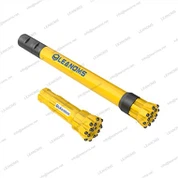
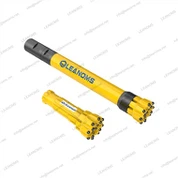
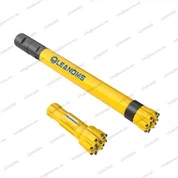
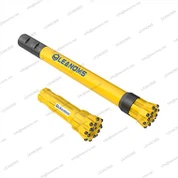
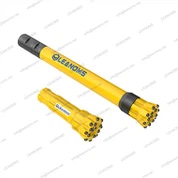
Products Description LEANOMS
The Reverse Circulation Water Well Drilling is considerably different from the other technologies discussed since it requires a very large rig with a vast footprint for both the rig itself and the settling pit that was built by a machine.
These rigs are often used to drill big-diameter wells up to 1000 feet deep in unconsolidated material, with a diameter of 24 to 50 inches.

In the Reverse Circulation Water Well Drilling , cutting operations like the rotary cut and rotary crush are employed. Cuttings are removed from the annular area between the drill string and the bore hole by water-based flushing, which is then sent back up the drill string and into the settling pit. In order to hold enough fluid to flush the significant quantity of cuttings produced during the drilling of a borehole of this diameter, this pit must be quite big.
Fluid needs to be added to the excavated material. The amount of fluid needed for this drilling technique grows as the drilling operation proceeds.
Since this approach often does not employ bentonite and does not completely seal the hole during drilling, a large volume of fluid is displaced and lost to the original formation in addition to the makeup fluid that is needed. This technology, as opposed to conventional mud rotary drilling, has the benefit of speeding up development but also increases the requirement for liquid consumption during borehole building.
Products Description LEANOMS
| Diameter | No x Button diameter, mm | Button angle° | Flushing holes | Shroud Diameter | Weight (KG) | Part Number | ||
| mm | Inch | Gauge Buttons | Front Buttons | |||||
| 86 | 3 2/5 | Φ12*6 | Φ12*5 | 35 | 2 | 84 | 6.0 | RE531-86 |
| 89 | 3 1/2 | Φ12*8 | Φ12*5 | 35 | 2 | 87 | 6.1 | RE531-89 |
| 95 | 3 3/4 | Φ12*8 | Φ12*6 | 35 | 2 | 93 | 6.3 | RE531-95 |
| 102 | 4 | Φ12*8 | Φ12*6 | 35 | 2 | 100 | 6.5 | RE531-102 |