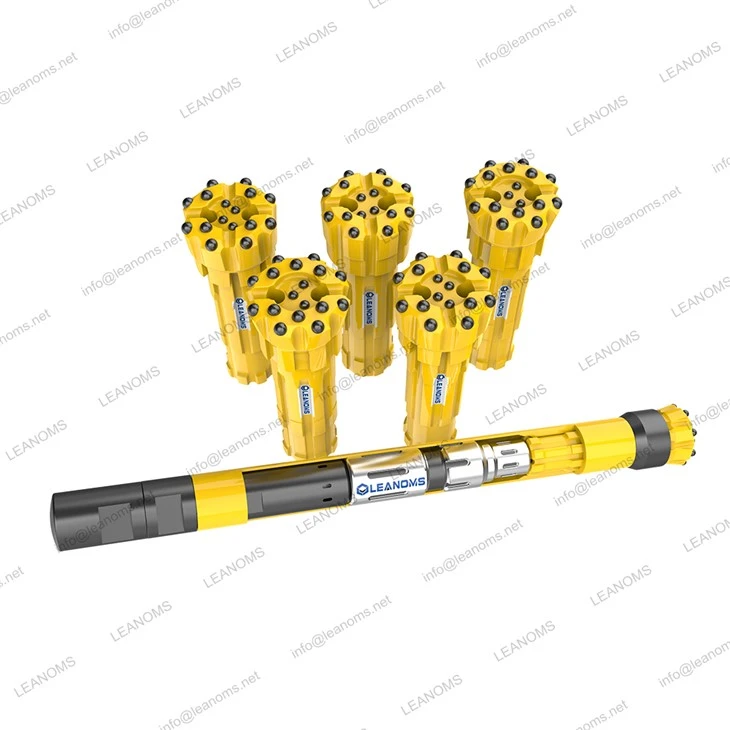

Products Description LEANOMS
Reverse rotary drilling (RRD) is a drilling technique that combines aspects of both reverse circulation drilling (RC) and rotary drilling. Like RC drilling, RRD uses a dual-walled drill pipe to transport cuttings to the surface through the annular space. However, instead of a rotating drill bit, RRD uses a percussion hammer to break up the rock formation. This technique is particularly useful in hard rock formations where conventional rotary drilling techniques may not be efficient.
The RRD process begins with the insertion of the dual-walled drill pipe into the ground, with the inner tube containing the percussion hammer and the outer tube serving as the casing. The percussion hammer operates by striking the drill bit at the bottom of the inner tube, which breaks up the rock formation. The cuttings produced by the drilling process are then transported to the surface through the annular space between the inner and outer tubes of the drill pipe.
As the cuttings reach the surface, they are collected in a cyclone separator, where the larger particles are separated from the smaller ones. The larger particles are then discharged onto the ground surface, while the smaller ones are transported to a sample collection unit for analysis.
One of the main advantages of RRD is its ability to drill through hard rock formations more efficiently than conventional rotary drilling techniques. The percussion hammer is able to break up the rock formation faster and more effectively than a rotating drill bit, allowing for faster and deeper drilling. This is particularly useful in mineral exploration and mining, where the ability to drill deep and accurately is essential for success.
Another advantage of RRD is its ability to maintain a stable borehole. The continuous flow of cuttings through the annular space helps to stabilize the borehole and prevent the formation from collapsing. This is important in deep drilling projects where the risk of borehole collapse can be high.
In addition, RRD is a more environmentally friendly method of drilling than conventional rotary drilling techniques. It produces less waste and uses less drilling fluid, reducing the environmental impact of the drilling process.
In conclusion, reverse rotary drilling is a highly effective and efficient drilling technique that combines the benefits of reverse circulation and rotary drilling. Its ability to drill through hard rock formations quickly and efficiently makes it a popular choice in mineral exploration, mining, and other industries. With its numerous advantages, reverse rotary drilling is likely to remain a popular drilling technique for years to come.

Specification LEANOMS
Reverse rotary drilling (RRD) has several advantages over conventional drilling methods, particularly when drilling in hard rock formations.
First, RRD is faster and more efficient than conventional rotary drilling. The percussion hammer used in RRD is able to break up rock formations more quickly and effectively than a rotating drill bit, allowing for faster and deeper drilling.
Second, RRD produces less waste and uses less drilling fluid, making it a more environmentally friendly method of drilling. This is because the cuttings produced by the drilling process are transported to the surface through the annular space, rather than being pumped to the surface with drilling fluid.
Third, RRD is able to maintain a stable borehole. The continuous flow of cuttings through the annular space helps to stabilize the borehole and prevent the formation from collapsing, reducing the risk of borehole instability and failure.
Fourth, RRD is a more cost-effective method of drilling. It requires less equipment and personnel than conventional drilling methods, which can help to reduce drilling costs.
Finally, RRD is a versatile drilling method that can be used in a variety of applications, including mineral exploration, geotechnical drilling, and water well drilling.
Overall, the advantages of RRD make it a highly effective and efficient drilling method for drilling in hard rock formations. Its ability to drill deep and accurately, while producing less waste and being more environmentally friendly, makes it a popular choice for a variety of drilling applications.