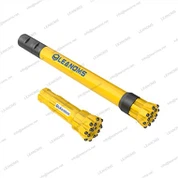
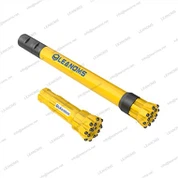
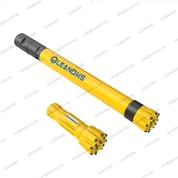
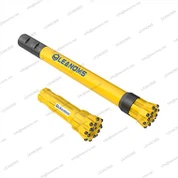
Reverse circulation drilling involves pumping drilling fluid to the annulus, where it passes through the RC bit and inside the drilling instrument before returning to the surface. It offers several benefits, including decreasing formation leakage, safeguarding the oil and gas formation, and cutting samples extremely clearly, among others. It comprises reverse circulation drilling with air lifting and pump sucking. Air lifting reverse circulation drilling requires air mixers, double wall drill tools, air tanks, air boxes, and reverse drilling bits, among other things.
RC Bit features the following things:
1. Based on prior knowledge of conventional RC Bit, combined with reverse circulation hammer characteristics, improved internal structure, and optimal energy transfer, assuring the series of RC Bit drilling with quick, smooth, and continuous sampling.
2. The interior structure is relatively straightforward with very robust components, guaranteeing the RC hammer's long lifespan and simplicity of maintenance.
3. The collecting tube has an integrated design and can be swapped out without the RC Bit needing to be taken apart. It has strong abrasion resistance after being carburized.
4. Equipped with bits designed with patent. The same hammer may drill holes of various diameters while guaranteeing that the sample is clean by simply changing the RC bit.
5. Sampling may be successfully completed in challenging conditions, such as those with loose soil, hard rock, and an abundance of water.
6. The RC hammer's interior structure is quite straightforward and made out of high stiffness components, assuring the hammer's long lifespan and ease of maintenance.
7. Without removing the hammer, the collecting tube adapters may be changed thanks to their integrated design.
8. It has strong abrasion resistance after carburizing treatment.
9. The same hammer may drill holes of various diameters with the use of patent-pending RC Bit, guaranteeing that the sample is not contaminated.

A dual wall pipe is used in RC drilling, also known as "Dual Wall Drilling" or "Centre Sample Recovery," where the drilling medium, typically high pressure air, is passed between the outer and inner tubes and then down to the face of the RC bit before being returned up the center tube along with the sample that the RC drill bit cut.