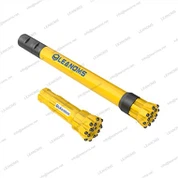
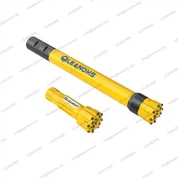
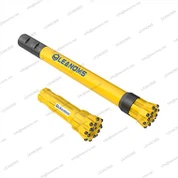
Products Description LEANOMS
Circulation Drill Bits are specialized tools used in reverse circulation drilling, a drilling technique used in mineral exploration, geotechnical drilling, and other applications. Here are some of the key opportunities and advantages of using Circulation Drill Bit:
1. Improved Sampling: RC drilling can provide higher quality rock samples than other drilling techniques, as the cuttings are transported to the surface through the drill string, rather than being mixed with drilling fluid. This can improve the accuracy of mineral exploration and geotechnical data.
2. Faster Drilling: Circulation Drill Bits are designed to drill through hard rock formations quickly and efficiently, allowing for faster drilling times and reduced costs associated with drilling.
3. Reduced Environmental Impact: RC drilling produces less waste than other drilling methods, as cuttings are transported to the surface through the drill string. This can help to minimize the environmental impact of drilling activities.
4. Versatility: Circulation Drill Bits can be used in a variety of drilling applications, including mineral exploration, geotechnical drilling, and water well drilling. This makes them a versatile tool for a range of drilling projects.
5. Lower Cost: RC drilling can be a cost-effective option for drilling in hard rock formations. It requires less drilling fluid than other drilling methods, which can help to reduce drilling costs.
6. Increased Safety: RC drilling is generally considered to be a safer drilling method than conventional drilling methods. This is due to the use of specialized equipment and the fact that cuttings are transported to the surface through the drill string, rather than being pumped to the surface with drilling fluids.
Overall, the use of Circulation Drill Bits can provide a range of opportunities and advantages for drilling projects, including improved sampling, faster drilling times, reduced environmental impact, versatility, lower cost, and increased safety. As the demand for RC drilling continues to increase, there may be opportunities for suppliers to offer competitive pricing and innovative solutions to meet the needs of their customers.

Specification LEANOMS

Reverse circulation (RC) drilling has been used for several decades in the mining and geotechnical industries, but the development of specialized Circulation Drill Bits has significantly improved the efficiency and accuracy of the drilling process.
The earliest RC drilling techniques were developed in the 1920s and 1930s and involved using a conventional drill bit to drill a pilot hole, followed by a specialized Circulation Drill Bit to collect samples from the bedrock. However, these early Circulation Drill Bits were relatively simple and had limited capabilities, which resulted in lower drilling efficiency and accuracy.
In the 1950s and 1960s, new advances in drilling technology led to the development of more sophisticated Circulation Drill Bits. These newer bits were designed to improve sample recovery and reduce drilling time, leading to increased efficiency and cost savings.
In the 1980s and 1990s, further advances in drilling technology led to the development of even more specialized Circulation Drill Bits. These bits incorporated new materials and designs to improve drilling efficiency and accuracy, as well as reduce drilling costs and environmental impact.
Today, Circulation Drill Bits continue to be developed and improved upon, with a focus on enhancing drilling speed, accuracy, and versatility. New materials and manufacturing techniques are being used to create stronger and more durable Circulation Drill Bits, and advanced digital technologies are being incorporated to improve drilling data collection and analysis.