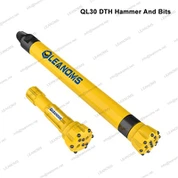
Products Description
LEANOMS
The QL40 DTH Hammer And Bits are tools used in the drilling and mining industry for creating boreholes and accessing underground resources. The term "DTH" refers to the drilling method where the hammer is placed at the end of the drill string and is responsible for generating the impact required to break through rock formations. The QL40 specification pertains to a specific size and type of DTH hammer and bits.
Here's a breakdown of the components and their roles:
DTH Hammer: The DTH hammer is a pneumatic tool that delivers powerful impacts to the drill bit. It operates by using compressed air to drive an internal piston that strikes the back of the bit, generating the necessary force to break the rock. The QL40 designation indicates a particular size and design of the hammer.
DTH Bits: The DTH bit is the cutting tool at the bottom end of the hammer. It comes in various designs to suit different rock formations and drilling requirements. The QL40 bits are designed to match the QL40 DTH hammer and are selected based on factors such as rock hardness, drilling depth, and desired drilling speed.
Drill String: The drill string consists of the drill pipe and other components that connect the DTH hammer to the surface drilling equipment. Compressed air is delivered through the drill string to the DTH hammer to power its operation.
The QL40 specification is part of a standardized classification system for DTH tools, which helps ensure compatibility between different manufacturers' equipment and simplifies the selection process for drillers. Each size and type of hammer and bit has its own performance characteristics, making it suitable for specific drilling conditions.
Key advantages of DTH drilling using tools like the QL40 DTH Hammer And Bits include:
- Efficient rock penetration: QL40 DTH Hammer And Bits deliver high-impact energy to the drill bit, enabling efficient penetration even through hard rock formations.
- Straighter holes: DTH drilling tends to produce more accurate and straighter boreholes compared to other drilling methods.
- Versatility: DTH drilling can be used in various applications, including mining, quarrying, construction, water well drilling, and geothermal exploration.
- Faster drilling: The impact-driven mechanism of DTH hammers allows for faster drilling speeds compared to some other drilling methods.
- Reduced hole deviation: The accuracy of DTH drilling results in reduced hole deviation, which is crucial when drilling for resources or constructing foundations.
When considering the use of QL40 DTH Hammer And Bits, it's important to consult with experts in the field and consider factors such as the specific rock types you'll be drilling, the drilling depth required, and the equipment compatibility with your existing setup.
Specification
LEANOMS
Technical Parameters Of QL40 DTH Hammers
|
Bit Shank |
QL40 |
|
Hole Range |
Φ110-130mm |
|
Connection Thread |
API 2 3/8" Reg |
|
Working Pressure |
10-25Bar / 1-2.5Mpa |
|
Speed Recommend |
30-70rpm |
|
Pull Force Recommend |
8KN |
|
Length |
1103mm |
|
Weight |
42.6Kg |
Technical Parameters Of QL40 DTH Bits
| Diameter |
Gauge Buttons |
Front Buttons |
Weight(KG) |
Part Number |
||||
|
mm |
Inch |
Flat Face |
Convex Face |
Concave Face |
Face Type |
|||
|
115 |
4 1/2 |
Φ14*7 |
Φ14*2 |
Φ14*4 |
/ |
Convex Face |
9.6 |
LN-QL40-115CV-1 |
|
115 |
4 1/2 |
Φ16*7 |
Φ14*2 |
Φ14*4 |
/ |
Convex Face |
9.6 |
LN-QL40-115CV-2 |
|
115 |
4 1/2 |
Φ14*8 |
Φ14*2 |
Φ14*4 |
/ |
Convex Face |
9.6 |
LN-QL40-115CV-3 |
|
125 |
4 15/16 |
Φ14*8 |
Φ13*3 |
Φ14*4 |
/ |
Convex Face |
10.2 |
LN-QL40-125CV |
|
127 |
5 |
Φ14*8 |
Φ13*7 |
/ |
/ |
Flat Face |
10.3 |
LN-QL40127FF |
|
130 |
5 1/8 |
Φ14*8 |
Φ14*7 |
/ |
/ |
Flat Face |
10.5 |
LN-QL40-130FF |