Products Description
LEANOMS
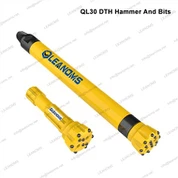
The Hydraulic Rock DTH Hammer is a specialized drilling tool used in various industries, primarily in mining, construction, and exploration. It offers several advantages over other drilling methods and hammers. Here are some advantages of hydraulic rock DTH hammers:
Efficient drilling: Hydraulic rock DTH hammers are known for their high drilling efficiency. They use a combination of high-pressure air and mechanical energy to rapidly hammer and break the rock formation. This efficient energy transfer allows for faster penetration rates compared to other drilling methods.

Deep hole drilling: DTH hammers are designed for deep hole drilling applications. They can achieve significant depths while maintaining drilling accuracy and productivity. This makes them suitable for tasks like geotechnical drilling, water well drilling, and mineral exploration.
Versatility: Hydraulic rock DTH hammers are compatible with various drilling rigs, including crawler-mounted, truck-mounted, and hydraulic excavator-mounted rigs. This versatility allows them to be used in different terrains and environments.
Superior hole straightness: DTH hammers provide excellent hole straightness, meaning they can drill precise and accurate holes. This is important in applications such as blasting, where accurate hole alignment is necessary for effective rock fragmentation.
Reduced deviation: Compared to other drilling methods, hydraulic rock DTH hammers experience reduced deviation while drilling. This minimizes the chances of encountering drilling complications or encountering unexpected geological formations.
Lower operating costs: DTH hammers have relatively lower operating costs due to their efficiency and productivity. They can complete drilling tasks in less time, requiring fewer consumables and lower maintenance costs.
Enhanced safety: Hydraulic rock DTH hammers offer enhanced safety features, such as pressure relief systems and safety interlocks, to prevent accidents and protect operators during drilling operations.
Environmentally friendly: DTH hammers produce fewer vibrations and noise compared to other drilling methods, resulting in less disruption to the surrounding environment and reduced impact on nearby structures.
Overall, the advantages of hydraulic rock DTH hammers make them a popular choice for various drilling applications, providing efficient, accurate, and cost-effective drilling solutions.
Disassembling a Hydraulic Rock DTH Hammer requires careful handling and knowledge of the specific model you are working with. While I can provide some general guidance, it's important to refer to the manufacturer's instructions and guidelines for your specific hammer model. Here are some steps you can follow:
Safety precautions: Before starting the disassembly process, ensure that you have proper safety gear, including gloves, protective eyewear, and appropriate tools. Make sure the hammer is depressurized and disconnected from any power sources.

Reference the manual: Obtain the manufacturer's manual or technical documentation for your hydraulic rock DTH hammer. It will provide specific instructions, diagrams, and part names, helping you understand the disassembly process better.
Prepare a clean workspace: Find a clean and organized area where you can disassemble the hammer. Lay out a clean cloth or a tray to keep small parts organized and prevent them from rolling away.
Identify and remove the retaining bolts: Most hydraulic rock DTH hammers have a front and back head assembly. Locate and remove the retaining bolts that secure the front and back heads together. Refer to the manual for the exact number and location of these bolts.
Separate the front and back heads: Once the retaining bolts are removed, carefully separate the front and back heads. They may be connected by threads, so gently unscrew them. If they are tightly secured, you may need a specialized tool like a hammer wrench or strap wrench to assist in separating the heads.
Remove the piston: Inside the hammer, you will find a piston. Depending on the design, it may be secured by additional bolts or a retaining pin. Refer to the manual for the specific method to remove the piston.
Disassemble the remaining components: After removing the piston, continue disassembling the remaining components, such as the chuck, wear sleeves, O-rings, and other parts. Follow the instructions in the manual to ensure you disassemble them correctly and avoid damaging any parts.
Inspect and clean: As you disassemble the hydraulic rock DTH hammer, carefully inspect each component for any signs of wear, damage, or buildup. Clean the parts using an appropriate cleaning solution and remove any debris or contaminants that may affect the hammer's performance.
Replace worn or damaged parts: If you identify any worn or damaged parts during the inspection, consult the manufacturer's guidelines for replacement parts and acquire the necessary replacements. Install the new parts following the reverse order of disassembly.
Reassembly: Once you have cleaned or replaced the necessary components, follow the manufacturer's instructions to reassemble the hydraulic rock DTH hammer. Make sure all parts are securely tightened and properly aligned.
Remember, this general guide may not cover all the specific steps and considerations for your particular hydraulic rock DTH hammer model. Always consult the manufacturer's instructions and guidelines for the most accurate and safe disassembly process.
Specification
LEANOMS
Technical Parameters Of QL80 DTH Hammers
|
Bit Shank |
QL80 |
|
Hole Range |
Φ195-254mm |
|
Connection Thread |
API 4 1/2" Reg |
|
Working Pressure |
10-25Bar / 1-2.5Mpa |
|
Speed Recommend |
20-45rpm |
|
Pull Force Recommend |
19KN |
|
Length |
1471mm |
|
Weight |
203Kg |
Technical Parameters Of QL80 DTH Bits
|
Diameter |
Gauge Buttons |
Front Buttons |
Weight(KG) |
Part Number |
||||
|
mm |
Inch |
Flat Face |
Convex Face |
Concave Face |
Face Type |
|||
|
203 |
8 |
Φ18*10 |
Φ18*8 |
/ |
Φ16*5 |
Concave Face |
50.1 |
LN-QL80-203CC |
|
216 |
8 1/2 |
Φ18*10 |
Φ18*8 |
/ |
Φ16*6 |
Concave Face |
54.3 |
LN-QL80-216CC |
|
219 |
8 5/8 |
Φ18*10 |
Φ18*8 |
/ |
Φ16*6 |
Concave Face |
54.8 |
LN-QL80-219CC |
|
229 |
9 |
Φ18*12 |
Φ16*12 |
/ |
Φ16*7 |
Concave Face |
56.4 |
LN-QL80-229CC |
|
235 |
9 1/4 |
Φ18*12 |
Φ16*12 |
/ |
Φ16*7 |
Concave Face |
57.4 |
LN-QL80-235CC |
|
245 |
9 5/8 |
Φ19*12 |
Φ16*12 |
/ |
Φ16*8 |
Concave Face |
61.5 |
LN-QL80-245CC |