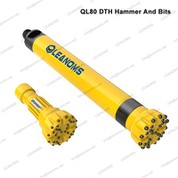
Products Description
LEANOMS

A Hydraulic DTH Hammer is a specialized drilling tool used in the mining, construction, and geotechnical industries for drilling holes in hard rock formations. It is designed to create percussion impacts at the bottom of the borehole, allowing for efficient and rapid drilling.
Here's how a hydraulic DTH hammer typically works:
Hammer Body: The Hydraulic DTH Hammer consists of a cylindrical body with an internal piston and valve system. It is made from high-quality alloy steel to withstand the high impact forces and drilling pressures.
Percussion Mechanism: The piston inside the Hydraulic DTH Hammer is powered by hydraulic pressure. When hydraulic fluid is supplied to the hammer, it pushes the piston downward, compressing the air or gas in the chamber below.
Valve System: The hammer has a valve system that controls the flow of compressed air or gas into the hammer. When the piston reaches the bottom of its stroke, the valve opens, allowing the high-pressure air or gas to rapidly expand into the hammer's internal chamber.
Impact Energy: As the compressed air or gas expands, it creates a high-velocity airflow that impacts a drill bit or drill string attached to the hammer. This impact energy is transferred to the drilling tool, breaking the rock formation.
Reverse Flow: After each impact, the valve system closes, preventing the backflow of air or gas. The piston then moves back up, compressing the air or gas again, preparing for the next impact.
Drilling Efficiency: The repeated percussive blows delivered by the hydraulic DTH hammer efficiently break the rock formation, and the drilling debris is flushed out of the borehole by injecting compressed air or water through the hammer.
Bit Replacement: The drill bit at the bottom of the hammer may wear out or break due to the demanding drilling conditions. It can be easily replaced by detaching the hammer from the drill string and fitting a new bit.
Hydraulic DTH hammers offer advantages such as high drilling speeds, precise hole control, and the ability to drill in hard and abrasive rock formations. They are commonly used in applications like mining exploration, quarrying, foundation drilling, water well drilling, and geothermal drilling.
Assembling a Hydraulic DTH (Down-The-Hole) hammer requires careful attention to detail and following the manufacturer's instructions. While I can provide a general guideline, please consult the specific instructions provided by the manufacturer for your particular model. Here are the steps involved in assembling a Hydraulic DTH hammer:
Gather the components: Ensure you have all the necessary components for the assembly, including the hammer body, piston, drill bit, drill pipe, seals, and any other accompanying parts.
Prepare the hammer body: Inspect the Hydraulic DTH Hammer body for any damage or wear. Clean the internal threads and surfaces of the hammer body using an appropriate solvent.
Install the seals: Follow the manufacturer's instructions to install the seals in the hammer body. This typically involves placing the seals in their designated grooves and ensuring they are properly seated.

Attach the piston: Insert the piston into the Hydraulic DTH Hammer body, ensuring it aligns correctly with the seals. Apply a suitable lubricant to facilitate smooth movement of the piston within the hammer body.
Install the drill bit: Attach the appropriate drill bit to the end of the piston. Make sure it is securely fastened using the recommended method, such as bolts or retaining pins.
Connect the drill pipe: Connect the drill pipe to the top of the Hydraulic DTH Hammer body. Use the specified method for joining the pipe to the hammer, such as threaded connections or quick-release mechanisms. Ensure a tight and secure connection.
Test the assembly: Before using the Hydraulic DTH Hammer, it's important to conduct a thorough inspection and perform a pressure test as per the manufacturer's guidelines. This ensures that all components are properly assembled, sealed, and capable of withstanding the required pressure.
Follow safety precautions: Always adhere to safety guidelines and use appropriate personal protective equipment when assembling or operating hydraulic equipment.
Remember, these steps provide a general overview of the assembly process. It's crucial to consult the specific instructions provided by the manufacturer of your Hydraulic DTH hammer, as the process may vary depending on the model and design.
Specification
LEANOMS
Technical Parameters Of QL80 DTH Hammers
|
Bit Shank |
QL80 |
|
Hole Range |
Φ195-254mm |
|
Connection Thread |
API 4 1/2" Reg |
|
Working Pressure |
10-25Bar / 1-2.5Mpa |
|
Speed Recommend |
20-45rpm |
|
Pull Force Recommend |
19KN |
|
Length |
1471mm |
|
Weight |
203Kg |
Technical Parameters Of QL80 DTH Bits
|
Diameter |
Gauge Buttons |
Front Buttons |
Weight(KG) |
Part Number |
||||
|
mm |
Inch |
Flat Face |
Convex Face |
Concave Face |
Face Type |
|||
|
203 |
8 |
Φ18*10 |
Φ18*8 |
/ |
Φ16*5 |
Concave Face |
50.1 |
LN-QL80-203CC |
|
216 |
8 1/2 |
Φ18*10 |
Φ18*8 |
/ |
Φ16*6 |
Concave Face |
54.3 |
LN-QL80-216CC |
|
219 |
8 5/8 |
Φ18*10 |
Φ18*8 |
/ |
Φ16*6 |
Concave Face |
54.8 |
LN-QL80-219CC |
|
229 |
9 |
Φ18*12 |
Φ16*12 |
/ |
Φ16*7 |
Concave Face |
56.4 |
LN-QL80-229CC |
|
235 |
9 1/4 |
Φ18*12 |
Φ16*12 |
/ |
Φ16*7 |
Concave Face |
57.4 |
LN-QL80-235CC |
|
245 |
9 5/8 |
Φ19*12 |
Φ16*12 |
/ |
Φ16*8 |
Concave Face |
61.5 |
LN-QL80-245CC |