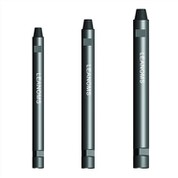
Products Description LEANOMS
Threading drill rods are specialized tools used in drilling operations, specifically in the mining and construction industries. These drill rods are designed with threaded connections on each end, allowing them to be joined together to form a longer drill string.
The threading on the drill rods enables them to be securely connected, providing a continuous path for transmitting rotational and axial forces from the drill rig to the drill bit. This threaded connection ensures a tight fit and prevents the rods from coming apart during drilling.
Threading drill rods typically have male threads on one end and female threads on the other end. The male threads are designed to fit into the female threads of the adjacent drill rod, creating a strong and reliable connection. The threads are precision-engineered to ensure proper alignment and maximum strength.
The drill rods are usually made of high-strength alloy steel to withstand the rigors of drilling operations. They are available in various lengths and diameters to suit different drilling requirements. The rods may also feature additional features such as a central flushing hole for water or air circulation during drilling.
Threading drill rods play a critical role in the drilling process, as they provide stability, transmit torque, and deliver flushing media to the drill bit. They are an essential component of a drill string and are vital for efficient and effective drilling operations.
It's important to note that the specific threading design and dimensions of drill rods may vary depending on the drilling method and the equipment being used. It is recommended to consult the manufacturer's specifications and guidelines for the appropriate threading drill rods for your specific application.
The production process of threading drill rods typically involves several steps. Here's a general overview of the process:
Material selection: High-quality steel is typically used for drill rods. The material needs to have good strength, durability, and resistance to wear and tear.
Cutting and shaping: The selected steel material is cut into appropriate lengths, typically ranging from several feet to several meters, depending on the requirements. The rods are then shaped into the desired diameter and outer surface smoothness using processes such as forging, extrusion, or machining.
Heat treatment: The drill rods undergo a heat treatment process to enhance their mechanical properties. This involves heating the rods to a specific temperature and then cooling them rapidly or slowly, depending on the desired properties. Heat treatment improves the hardness, toughness, and strength of the rods.
Threading: Threading is a crucial step in the production process of drill rods. It involves creating threads on one or both ends of the rod to allow for the attachment of various drilling tools and accessories. The threading process can be performed using different methods, including cutting, rolling, or grinding.
Cutting: Thread cutting involves using a lathe or a specialized threading machine to cut the threads into the drill rod. The machine is set up with the appropriate cutting tool and the rod is rotated while the cutting tool gradually forms the threads.
Rolling: Thread rolling is another method where hardened steel dies are used to press the threads into the drill rod. The rod is typically fed between two dies that have the reverse image of the desired threads. As the dies rotate, they apply pressure to the rod, causing the material to deform and form the threads.
Grinding: Thread grinding is a precise method that involves using a grinding wheel to remove material and create the threads. This process is typically used for producing high-precision threads and requires specialized grinding machines.
Inspection and quality control: Once the threading process is complete, the drill rods undergo thorough inspection and quality control measures. This includes checking the dimensions, thread quality, surface finish, and overall integrity of the rods. Defective rods are rejected, and only those meeting the specified standards are approved for further use.
Finishing and coating: After passing inspection, the drill rods may undergo additional finishing processes to remove any burrs or sharp edges. They may also be coated with protective layers, such as rust-resistant coatings or lubricants, to enhance their durability and resistance to corrosion.
Packaging and distribution: Finally, the finished drill rods are packaged and prepared for distribution to customers or for storage in warehouses. They are typically grouped and secured to ensure safe transportation and handling.
It's important to note that the specific details of the production process may vary depending on the manufacturer, the type of drill rod, and the intended application. The steps mentioned above provide a general overview of the typical process involved in producing threaded drill rods.
Specification LEANOMS

|
Thread Type |
Model |
|
API REG |
2 3/8 API REG / 2 7/8 API REG / 3 1/2 API REG / 4 1/2 API REG / 5 1/2 API REG / 6 5/8 API REG |
|
NC(IF) |
NC23 / NC26(2 3/8 API IF) / NC31(2 7/8 API IF) / NC3/ NC38(3 1/2 API IF) / NC40 / NC46 / NC50(4 1/4 API IF) |
|
Beco |
3 / 3 ½ / 4 / 4 ½ / 5 ¼ / 6 / 8 / 10 BECO |