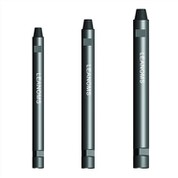
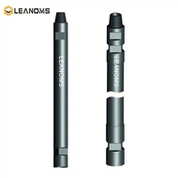
Friction Welding Drill Pipe | DTH Drill Pipe Manufacturer – LEANOMS
Quick Summary
Product Description LEANOMS
 Friction welding drill pipe is a high-strength, solid-state welded drill string component designed for DTH (down-the-hole) drilling, water-well drilling, mining, quarrying, and geotechnical exploration. Unlike conventional arc-welded or flash-butt-welded alternatives, friction welding generates no melting zone, no porosity, and no heat-affected zone weakness. The result is a joint that approaches the mechanical properties of the parent material - delivering superior resistance to cyclic torque, axial compression, and high-pressure air in demanding downhole environments.
LEANOMS sources seamless alloy steel tube as the base pipe and friction-welds precision-machined tool joints at both ends under controlled axial load and rotational speed. The process eliminates filler material and shielding gas dependency, producing a repeatable, auditable weld every time. Full API thread compatibility - including REG and IF profiles - ensures interoperability across standard drill rigs without adapter sleeves.
Product Overview at a Glance
| Field | Details |
|---|---|
| Product Name | Friction Welding DTH Drill Pipe |
| Welding Method | Solid-state rotary friction welding (no filler, no arc) |
| Base Material | Seamless alloy steel tube (superior-grade) |
| Outer Diameter Range | 76 mm – 140 mm (standard); custom OD on request |
| Standard Lengths | 1,000 / 1,500 / 2,000 / 3,000 / 5,000 / 6,000 mm |
| Thread Standards | API REG (2 3/8″, 2 7/8″, 3 1/2″, 4 1/2″); API IF (2 3/8, 3 1/2) |
| Key Applications | DTH drilling, water-well drilling, mining, quarrying, geotechnical exploration |
| Rig Compatibility | Standard API rigs; Atlas Copco F6/L6/L8, IR T4, Schramm T64, Sandvik Driltech D25/D40K |
| Customization | OD, wall thickness, length, thread profile, heat treatment grade - all available |
| Supply Type | OEM / ODM / Project bulk order / Distributor wholesale |
What Is Friction Welding Drill Pipe?
In conventional drill-pipe manufacturing, tool joints are attached to the tube body using arc welding or threaded mechanical connections. Both approaches introduce potential failure points: arc welds create a heat-affected zone where grain structure weakens, and mechanical connections can loosen under vibration. Friction welding eliminates both issues by using rotational kinetic energy to generate plasticized metal at the interface. When axial forge pressure is then applied, the two components bond at the atomic level - producing a joint with no fusion zone, no slag inclusions, and no gas porosity.
For drilling operations - where pipes cycle between compression, tension, and torsion thousands of times per shift - this difference in weld integrity directly translates to fewer downhole failures, longer string life, and lower total replacement cost per meter drilled.
Who Uses DTH Friction Welding Drill Pipe?
DTH drill pipe is used by a wide range of buyers across extraction and civil construction sectors:
- Water-well drilling contractors - looking for pipe that handles the percussion cycles of a DTH hammer without fatigue cracking at the weld zone.
- Mining and quarry operators - requiring high torque capacity and dimensional consistency for efficient blast-hole drilling.
- Geotechnical and foundation contractors - needing accurate hole inclination and pipe straightness over long string depths.
- Rig equipment distributors and OEM buyers - sourcing branded pipe sets or private-label drill strings for regional markets.
- Oil and gas service companies - where API certification and material traceability are non-negotiable purchasing requirements.
Key Technical Features
1. Solid-State Weld - No Porosity, No Filler
The friction welding process creates a forged bond rather than a cast bond. This means the weld zone has no entrapped gas, no flux residue, and no underfill - failure modes that typically initiate cracks in arc-welded pipes under cyclic downhole loading.
2. Seamless Alloy Steel Tube Body
The pipe body is drawn from seamless alloy steel, free from the longitudinal seam weld that is the primary weakness of ERW (electric resistance welded) pipe under internal pressure and external impact. Superior-grade alloy selection ensures the pipe body meets or exceeds API Spec 7-1 material requirements.
3. Full API Thread Compatibility
Both REG (regular) and IF (internal flush) API thread profiles are available, machined to gauge-verifiable tolerances. This allows the pipe to connect directly into standard drill string configurations without adapter subs, reducing connection points and potential leak paths.
4. Air-Delivery and Force-Transmission Design
The internal bore of each friction welding drill pipe is engineered to deliver high-pressure air to the DTH hammer with minimal pressure drop, while the pipe wall and tool joint dimensions are optimized to transmit rotational torque and axial down-force simultaneously. The balance between ID air-flow efficiency and wall structural strength is a key differentiator in pipe design.
5. Rig-Specific Compatibility
In addition to standard API-thread pipes, special-configuration pipes are manufactured for Atlas Copco F6, L6, and L8; Ingersoll Rand T4; Schramm T64; and Sandvik Driltech D25 and D40K. These rig-matched pipes avoid the performance compromise of generic adapters and ensure full thread engagement across the string.
Specification LEANOMS
Full Specification Reference
|
Parameter |
Standard Options | Custom Range |
|---|---|---|
| Outer Diameter (OD) | 76 / 89 / 102 / 114 / 127 / 140 mm | Non-standard OD on request |
| Length | 1,000 / 1,500 / 2,000 / 3,000 / 5,000 / 6,000 mm | Custom length per project requirement |
| Thread Profile (API REG) | 2 3/8″ / 2 7/8″ / 3 1/2″ / 4 1/2″ API REG | Rig-matched special threads available |
| Thread Profile (API IF) | 2 3/8 / 3 1/2 API IF | – |
| Tube Body Material | Seamless alloy steel (superior grade) | Higher tensile / hardened grades on request |
| Welding Method | Rotary solid-state friction welding | – |
| Heat Treatment | Q+T (quench and temper) standard | Hardness and Charpy impact spec on request |
| Surface Finish | Mill finish / painted / zinc phosphate on request | Custom corrosion protection coatings |
| Special Rig Fit | Atlas Copco F6/L6/L8, IR T4, Schramm T64, Sandvik D25/D40K | Other rig models on drawing review |
| Inspection Standard | Dimensional, thread gauge, straightness, UT (on request) | Third-party inspection supported |
| Packing Method | Thread-protector caps + steel bundle / wooden crate | Reinforced export crate for long-distance shipping |
| Lead Time (Standard) | 15–30 days depending on spec and quantity | Priority production available for urgent project orders |

Friction Welding vs. Conventional Welding: What the Numbers Mean for Your Project
Buyers frequently ask whether the price premium of friction-welded pipe is justified. The table below compares the two manufacturing approaches across the criteria that matter most in a procurement decision:
| Criterion | Friction Welding Drill Pipe | Arc / Flash-Butt Welded Pipe |
|---|---|---|
| Weld Zone Integrity | Solid-state, no porosity, near-parent-metal strength | Fusion zone - possible porosity and HAZ weakness |
| Fatigue Life Under Cyclic Load | High - consistent grain structure throughout | Lower - HAZ initiates fatigue cracks earlier |
| Dimensional Repeatability | Machine-controlled axial alignment every cycle | Operator-dependent; alignment variance higher |
| Production Speed | Seconds per weld - high throughput | Minutes per weld - slower |
| Filler / Shielding Gas Cost | None required | Ongoing consumable cost |
| Weld Inspection Requirement | Minimal - process is inherently controlled | NDT mandatory to detect hidden defects |
| Downhole Failure Risk | Lower - validated by oil, gas, and mining industry use | Higher at weld zone under combined loading |
Note: The cost of one downhole pipe failure - including fish-out service, rig down-time, and re-drilling - typically exceeds the price difference between standard and friction-welded pipe by a significant margin. Procurement teams should factor total project cost, not just unit price.
The Value Edge: Factory Direct vs. Standard Trading Company
| Buying Criteria | LEANOMS (Factory Direct) | Standard Trading Company |
|---|---|---|
| Unit Price | Lower - no middle-layer markup; margin stays in the factory | Higher - trading margin added on top of factory cost |
| Material Quality Control | A-grade material selection enforced in-house; every batch traceable | Depends on sub-supplier; limited visibility on actual mill certificate |
| Customization | OD, length, thread, heat treatment - all managed internally; fast turnaround on drawings | Custom orders relayed through a third party; longer lead time, higher minimum |
| Technical Communication | Engineering team answers rig-specific or spec-specific questions directly | Sales team acts as relay; technical accuracy may be lost in translation |
| Pre-Shipment Inspection | Photo / video documentation; third-party inspection coordination available | Access to factory floor limited; inspection harder to arrange |
| After-Sales Support | Direct replacement, remuneration, or re-make negotiated with the producing team | After-sales disputes routed through intermediary; resolution slower |
Same budget → better material grade and tighter process control when ordering factory direct. Same grade → lower unit cost with equivalent lead time. The difference is not just price - it is accountability at every step of the supply chain.
Addressing the Top Buyer Concerns Before You Order
Concern 1: Pipe damage or thread damage during shipping
Each friction welding drill pipe ships with fitted plastic thread-protector caps on both box and pin ends. Pipes are bundled in steel-strapped groups and loaded into reinforced wooden export crates with internal dunnage blocking. For long-length pipes (5,000–6,000 mm), custom steel cradle frames are available on request. Thread condition can be verified via pre-shipment photograph documentation shared with the buyer before container loading.
Concern 2: Dimensional variation between batches
Friction welding is a machine-controlled, parameter-locked process - rotational speed, forge pressure, and upset distance are set and monitored per weld. This means batch-to-batch OD, length, and thread-fit consistency is governed by the process, not by individual welder skill. Dimensional inspection reports, thread gauge records, and material heat numbers can be provided as part of the shipping documentation package.
Concern 3: Urgent or short-lead-time project orders
Standard-spec pipes (API REG and IF threads in common ODs) are held in semi-finished stock at the factory, enabling faster completion for repeat or standard configurations. For urgent project orders, priority production line scheduling is available on confirmation. Lead time estimates are provided with the quotation and confirmed at order placement - not adjusted unilaterally after payment.
Concern 4: Specification changes after sample approval
Production is locked to the approved sample specification or confirmed drawing at order placement. Any material change requires written buyer approval before production proceeds. Full pre-shipment photo and video approval is offered as standard, allowing buyers to verify conformance remotely before goods leave the factory.
Concern 5: Post-delivery quality disputes
In the event of confirmed manufacturing defects - dimensional non-conformance, weld failure, or thread form error - the standard resolution path includes replacement supply, partial credit, or re-make, depending on the scale and nature of the issue. All claims are handled directly with the manufacturing team, not through a third-party intermediary.
Common Buyer Mistakes When Selecting DTH Drill Pipe
Experienced procurement teams avoid these errors - make sure your evaluation covers each point:
- Selecting pipe by OD only without confirming wall thickness and ID clearance. Air-flow performance at the DTH hammer is determined by the internal bore area, not the OD. Confirm ID alongside OD in the specification.
- Assuming all "API thread" pipes are interchangeable. API REG and API IF have different taper angles and shoulder geometry. Mixing profiles in a drill string causes poor make-up torque and elevated connection failure risk.
- Ordering generic pipe for rig-specific applications without checking the rig data sheet. Atlas Copco, Sandvik, and Schramm rigs have specific sub-connection dimensions that must be matched, not approximated.
- Focusing on FOB unit price without factoring packing and freight preparation. Long drill pipes (5–6 m) require specific container loading arrangements. A low FOB price combined with inadequate export packing can result in transit damage that cancels the saving.
- Not requesting material certification and weld inspection records. For project work or resale, the ability to produce a mill certificate and weld inspection record is often required by the end client or site engineer. Confirm this is included before placing the order.
How to Evaluate Before Ordering
A practical pre-order checklist for DTH drill pipe procurement:
- Confirm OD, ID, wall thickness, and length against your rig's sub-connection specification.
- Specify the thread profile (REG or IF) and verify gauge conformance is documented.
- Request the material grade and heat treatment specification, including tensile strength and hardness targets.
- Confirm whether the supplier manufactures in-house or sub-contracts the friction welding operation.
- Ask for weld inspection records or ultrasonic test reports from previous orders of the same pipe size.
- Review the packing method and confirm thread-protector caps are included.
- Clarify lead time in writing at order placement, and confirm whether semi-finished stock is available for your size.
Frequently Asked Questions
1. What is a friction welding drill pipe and how is it different from a standard welded drill pipe?
A friction welding drill pipe is manufactured by rotating two metal components against each other at high speed until heat and plastic deformation fuse them together permanently. Unlike conventional arc or flash-butt welding, friction welding produces no melting zone, no porosity, and no filler material - the bond is a fully forged, solid-state joint. This means the weld zone reaches mechanical properties close to the parent material, which is critical when drill pipes must withstand cyclic torque, axial compression, and high-pressure air delivery in deep-hole and DTH drilling applications.
2. What diameters and lengths are available for DTH drill pipe?
Standard outer diameters range from 76 mm to 140 mm, covering sizes of 76 mm, 89 mm, 102 mm, 114 mm, 127 mm, and 140 mm. Standard lengths include 1,000 mm, 1,500 mm, 2,000 mm, 3,000 mm, 5,000 mm, and 6,000 mm. Thread options include 2 3/8″ API REG, 2 7/8″ API REG, 3 1/2″ API REG, 4 1/2″ API REG, 2 3/8 API IF, and 3 1/2 API IF. Special-purpose versions compatible with Atlas Copco, Ingersoll Rand, Schramm, Sandvik, and Driltech rigs are also available on request.
3. Which rig brands is this drill pipe compatible with?
Standard API-thread drill pipes are compatible with most DTH drill rigs. Additionally, special-fit pipes are produced for Atlas Copco F6, L6, and L8; Ingersoll Rand T4; Schramm T64; and Sandvik Driltech D25 and D40K. If you are running a different rig model, please share the rig specification and we can confirm compatibility or manufacture a matched set.
4. What quality checks are done before shipment?
Each friction welding drill pipe goes through dimensional inspection (OD, ID, length, thread pitch), weld-zone ultrasonic testing or magnetic particle inspection where applicable, thread gauge verification, surface finish and straightness check, and hydrostatic or pressure tests on request. Pre-shipment photo and video documentation is available so buyers can verify conformance before the goods leave the factory. Custom third-party inspection arrangements can also be coordinated.
5. Can I order custom lengths, non-standard diameters, or special heat treatment grades?
Yes. Custom outer diameters, wall thicknesses, and lengths are supported for project orders or rig-specific requirements. Material options include standard alloy steel and higher-grade alternatives with specific hardness or tensile strength targets. Heat treatment - including quenching and tempering - can be specified if the application involves particularly high percussion energy or corrosive downhole environments. Minimum order quantities for custom configurations depend on the specification; contact the sales team with your technical drawing or rig data sheet.
Buyer's Decision Summary
What matters most in this product category:
Weld integrity is the defining quality variable for friction welding drill pipe. A solid-state friction weld eliminates the porosity, HAZ weakness, and dimensional variance that arc or flash-butt welded pipes introduce. For buyers operating in high-cycle DTH environments - water-well drilling, quarry blasting, or geotechnical boring - weld failure downhole is the most expensive failure mode in the drill string. Weld quality is not a premium feature; it is a project risk management decision.
Why buyers choose LEANOMS friction welding drill pipe:
Factory-direct supply, full API thread range coverage (REG and IF), compatibility with the leading rig brands, confirmed customization capability for OD, length, and heat treatment grade, and documented pre-shipment inspection. These factors combine to reduce procurement risk and support confidence in placing project-volume orders without a local inspection agent present.
What to confirm before ordering:
OD, ID, wall thickness, pipe length, thread profile (REG or IF), rig connection dimension, material heat number and mill certificate availability, weld inspection record format, packing method, and lead time commitment in writing. If the order is for a specific rig model, provide the rig data sheet or existing pipe sample for dimensional verification before production.
Best-fit project types:
DTH water-well drilling programmes; quarry and mine blast-hole drilling fleets; geotechnical soil and rock investigation projects; civil construction dewatering and foundation drilling; oil and gas service contractors requiring API-certified pipe strings; regional equipment distributors building private-label or OEM pipe inventories.
Commercial advantage summary:
Factory-direct pricing removes intermediary margin. In-house friction welding capability means customization requests do not require sub-contractor coordination or extended lead times. Material traceability, weld inspection documentation, and pre-shipment photo verification are standard - not optional add-ons. The result is a procurement process with fewer unknowns and a supplier relationship with direct technical accountability.
Market and quality context:
Friction welding as a joining method is used in aerospace, automotive, nuclear, and energy drilling applications where weld reliability under cyclic load is non-negotiable. Its adoption in the drill pipe manufacturing industry reflects the same engineering rationale: consistent, verifiable joint quality at production speed. API Spec 7-1 governs rotary drilling equipment including drill pipe, and procurement teams should confirm that the supplied pipe meets or references this standard for material, dimension, and thread form.