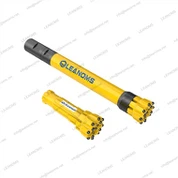
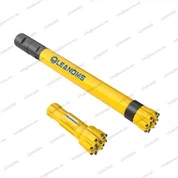
Products Description LEANOMS
The development history of RC drilling:
Reverse Circulation (RC) drilling has a rich development history that spans several decades. The technique was first introduced in the 1970s as a means to overcome challenges encountered in drilling deep holes in hard rock formations for mineral exploration and mining purposes.
The development of RC drilling can be attributed to the need for efficient and cost-effective drilling methods that could penetrate hard and abrasive formations. Prior to RC drilling, conventional drilling techniques faced difficulties in achieving high penetration rates and efficient cuttings removal in such challenging conditions.
In the early stages of RC drilling, the focus was primarily on improving the design of the drill bit and optimizing the flow of drilling fluid. Innovations such as the introduction of larger diameter drill bits with strategically placed flushing holes were made to enhance cuttings removal and improve drilling efficiency.
Over time, advancements were made in the design of RC drill bits, including the incorporation of tungsten carbide buttons or teeth for enhanced rock-breaking capabilities. The cutting structures of RC drill bits were also optimized to deliver higher penetration rates and increased durability.
Parallel to the developments in drill bit design, improvements were made in the hydraulic systems and equipment used for RC drilling. Enhanced pump technologies, efficient mud mixing systems, and specialized cyclones were developed to ensure effective circulation and removal of cuttings from the drill hole.
The adoption of RC drilling gradually expanded as its advantages became evident. The technique proved to be highly efficient in hard rock drilling, offering faster penetration rates, improved cuttings removal, and reduced drilling costs compared to conventional methods.
Today, RC drilling has become a widely used technique in mineral exploration and mining operations worldwide. Ongoing research and development efforts continue to refine RC drilling technologies, focusing on optimizing drilling efficiency, improving bit designs, enhancing cuttings management systems, and expanding its applicability to various geological conditions.
The continuous evolution of RC drilling techniques and equipment has played a pivotal role in enabling efficient and productive drilling in challenging rock formations, supporting the exploration and extraction of valuable mineral resources.

Specification LEANOMS
Reverse Circulation (RC) drilling is extensively used in mineral exploration and mining operations due to its numerous applications and associated benefits. Here are the key applications and benefits of RC drilling:
Applications of RC Drilling:
1. Mineral Exploration: RC drilling is commonly employed in mineral exploration projects to obtain valuable geological information. It is used to identify and delineate mineral deposits, determine the presence of economic mineralization, and define the geological structure of the subsurface.
2. Resource Definition: RC drilling is crucial for resource definition projects, where the aim is to estimate the size, grade, and distribution of mineral resources. It helps in determining the boundaries and continuity of mineralized zones, providing vital data for resource estimation and mine planning.
3. Grade Control: RC drilling plays a vital role in grade control programs during mining operations. It enables accurate sampling and analysis of mineralized zones, ensuring optimal ore recovery and minimizing waste. RC drilling helps in delineating high-grade zones and guiding mining operations to maximize economic returns.
4. Geotechnical Investigations: RC drilling is utilized for geotechnical investigations to assess the stability of rock formations and determine the suitability of sites for infrastructure development. It provides data on rock strength, fractures, and ground conditions, assisting in designing safe and stable mine structures.
Benefits of RC Drilling:
1. Efficient and Rapid Drilling: RC drilling offers high penetration rates in hard rock formations, allowing for efficient and rapid drilling progress. This leads to reduced drilling time, increased productivity, and cost savings in mineral exploration and mining projects.
2. Excellent Cuttings Removal: RC drilling provides effective cuttings removal due to its reverse circulation system. The drilling fluid flows downward inside the drill rods, carrying cuttings up to the surface through the annular space between the rods and the drill hole. This results in a clean hole, minimizing the risk of blockages and improving drilling efficiency.
3. Sample Quality: RC drilling enables the collection of high-quality samples, particularly for grade control and resource definition purposes. The reverse circulation system helps in obtaining representative samples of mineralized zones, facilitating accurate geological and metallurgical analysis.
4. Versatility: RC drilling is adaptable to various ground conditions, including hard rock, abrasive formations, and variable lithologies. Its versatility makes it suitable for a wide range of mineral exploration and mining projects, providing consistent performance and reliable results.
5. Cost-Effective: The efficient drilling rates, improved cuttings removal, and reliable sample collection offered by RC drilling contribute to cost-effectiveness in mineral exploration and mining operations. It reduces drilling expenses, increases productivity, and aids in informed decision-making, leading to optimized resource extraction and economic viability.
In summary, RC drilling finds wide application in mineral exploration and mining due to its efficiency, accurate sampling, excellent cuttings removal, versatility, and cost-effectiveness. These benefits make it a valuable technique for obtaining geological data, defining mineral resources, guiding mining operations, and ensuring efficient and sustainable resource extraction.