Company Profile
LEANOMS
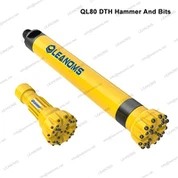
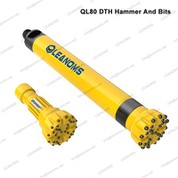
We produce rock dth hammer rock drilling tools for mining, tunneling, construction, and rock drilling related industries.
For more than two decades, LEANOMS has been striving to provide customers reliable rock dth hammer consumables to consistently save their total drill cost.
LEANOMS mainly produces rock dth hammer for mining, construction and related industries. Since its foundation in 1997, LEANOMS has been striving to provide customers with fast, stable and economical solutions for rock drilling, and effectively help them reduce rock drilling cost. Now LEANOMS has been a specialized manufacturer of rock drilling tools with integration of R&D, production, related products suppling and solution consultancy.
With constant efforts for more than 20 years, not only does LEANOMS own its own factories and laboratory but also has established strategic partnership with a number of outstanding raw material vendors. We can offer customers custom-made services solution based upon the full understanding of their specific requirements, and a wide range of actual performance tests of our products under the rigorous control on production quality and supplying system.
How Does rock dth hammer Works?
LEANOMS
The rock dth hammer is typically powered by a source of compressed air. The compressed air is supplied from an air compressor through hoses to the rock drill. Inside the rock drill housing, there is a piston that moves back and forth within a cylinder. Attached to the piston is a hammer bit or chisel, which is the part that actually strikes the rock or material.
The rock drill has a valve system that controls the flow of compressed air into the cylinder. This valve system determines the timing and force of the hammer blows. When compressed air is released into the cylinder, it drives the piston forward with high speed and force. The piston strikes the back end of the hammer bit, propelling it forward and causing it to strike the rock surface with tremendous energy.
The rapid, high-energy impacts of the hammer bit against the rock create fractures and cracks in the material. Over time, repeated impacts gradually break the material apart, allowing for the drilling or excavation of holes. After the piston reaches the end of its stroke, the valve system redirects the compressed air to the opposite side of the piston. This causes the piston to retract, pulling the hammer bit back to its starting position.
The process repeats itself continuously, with the piston and hammer bit moving back and forth to deliver a series of impacts to the drilling surface. The rate of impact is determined by the frequency of the compressed air pulses and can be adjusted for different drilling requirements.
The effectiveness of a rock drill hammer is based on the rapid, repetitive impact force it delivers to the material, which gradually breaks it apart and creates a hole or cavity. Rock drill hammers are commonly used in construction, mining, quarrying, and other industries where drilling into hard surfaces is required.
Advantage
LEANOMS
Advantages of DTH drilling with a DTH Drill Hammer:
High Penetration Rates: DTH drill hammers are known for their ability to provide rapid and efficient drilling, allowing for high penetration rates in various rock formations.
Versatility: DTH drilling can be adapted to a wide range of drilling applications and geological conditions, making it suitable for tasks ranging from mining to construction and environmental exploration.
Precision: DTH drilling offers good hole straightness, making it ideal for tasks where hole accuracy is critical.
Reduced Hole Deviation: The hammer's impact action minimizes hole deviation, resulting in more accurate drilling and reduced waste.
Reliability: DTH drill hammers are known for their durability and reliability, even in challenging drilling environments.
Danger
LEANOMS
Explosion hazard
If a rock drilling tool comes into contact with an explosive, an explosion may occur. Explosions may cause serious or mortal injuries. To reduce such risk of explosion, never drill near any explosive, including dynamite or other explosives in the rock. Make sure that there are no explosives in the rock. Never drill in an old hole.
Drilling can cause sparks, which may ignite explosive gases and cause explosions.
Explosions may cause serious or mortal injuries. To reduce such risk of explosion, never drill in any explosive environment. Make sure that there are no undetected sources of gas.