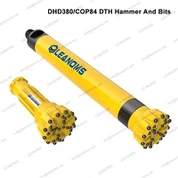
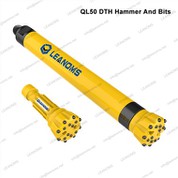
Products Description LEANOMS
A Well Drilling DTH Hammer is a highly efficient tool used for drilling. It breaks rocks by applying high-frequency impact force at the drill bit combined with rotary motion. This technology is particularly suitable for drilling holes in hard rock formations because it takes advantage of the brittle nature of rock, which is that although the rock is hard, it has low shear strength and is not resistant to impact force.
Products Advantage LEANOMS
As a professional drilling tool factory, we are proud to introduce the advantages of Well Drilling DTH Hammer drilling technology, which is one of our core technologies in modern drilling engineering. The following are the advantages of our product, down-the-hole hammer, and corresponding data support:
1. Drilling efficiency
Our products have significant advantages in drilling efficiency. The down-the-hole hammer is driven by compressed air to achieve high-frequency impact and rotational cutting of the rock at the bottom of the hole, quickly breaking the rock. Our practice has proven that the drilling efficiency of Well Drilling DTH Hammer is 2 to 5 times higher than that of hydraulic down-the-hole hammers, and 3 to 10 times higher than that of carbide rotary drilling. In bedrock areas, our down-the-hole hammer drilling efficiency can reach 6-8 meters/hour, up to 10 meters/hour.
2. Adaptability
Our Well Drilling DTH Hammer drilling technology is suitable for various complex geological conditions, including hard rock formations, fracture zones, fracture development zones, etc. This technology is even more superior when used in water-scarce areas, and has strong adaptability to the changing climate conditions in northern areas.
3. Drill bit cost
The ball-tooth carbide drill bit used in our Well Drilling DTH Hammer drills into hard broken rock, which is beneficial to rock breaking and has a longer service life than ordinary carbide drill bits, thus greatly reducing the cost of the drill bit. In bedrock areas, the service life of our down-the-hole hammer ball-tooth drill bits can reach 400-600 meters per piece.

4. Drilling verticality
Our Well Drilling DTH Hammer drilling technology excels at maintaining hole verticality. Due to the low drilling speed and small centrifugal force, the chance of the drilling tool hitting the hole wall is small. The general hole inclination of our drilling is ≤0.5°/100 meters.
5. Weight on bit and torque requirements
Our Well Drilling DTH Hammer drilling requires much less drilling pressure and torque than traditional rotary drilling, which can reduce the quality and power of supporting drilling equipment and reduce equipment costs. For a down-the-hole hammer with a diameter of 290mm, the drilling pressure should be 25~28kN.
6. Environmental impact
Our Well Drilling DTH Hammer drilling uses air as the circulating medium and does not require mud, so it does not cause pollution to the environment. Only a very small amount of production water is required during construction, which can save production water costs at construction sites with drought and lack of water sources.
7. Construction costs
Due to the high efficiency of our DTH hammer drilling technology and low drill bit costs, construction costs can be significantly reduced. Compared with ordinary cone rotary drilling, our down-the-hole hammer drilling saves about 30% of drilling costs.
8. Finished well quality
Our Well Drilling Dth Hammer drilling does not require mud as a circulating medium. Therefore, when mud leakage occurs in the fracture zone and fissure development zone, there is no need to take wall protection measures and plugging materials. This reduces the impact of mud on the permeability of the aquifer and ensures the completion of the well. quality.
To sum up, our down-the-hole hammer drilling rig technology has shown significant advantages in many aspects, especially in drilling efficiency, adaptability, cost control, environmental protection, etc., which makes our down-the-hole hammer drilling rig technology in It has been widely used in various drilling projects, allowing more customers in the drilling industry to benefit from it and improving project productivity.
Applicant LEANOMS

Mine blasting holes:
Down-the-hole hammers were originally used mainly for drilling mine blasting holes. Due to their efficient drilling speed and adaptability to hard rock formations, they have been widely used in the field of mining.
Hydropower, railway, and highway construction:
Down-the-hole hammer technology has also played an important role in hydropower projects, railways, and highway construction, especially in the drilling of hard rock and pebble layers, the efficiency is several to dozens of times higher than conventional methods.
Water well drilling:
In water well construction, down-the-hole hammers are favored for their high efficiency and long drill bit life, especially in geological exploration and development, foundation engineering construction, hydrological water well drilling and other engineering fields.

Down-the-hole hammer has good application prospects in geotechnical engineering construction, especially in the fields of large-diameter engineering holes and life-saving holes.
Prestressed pipe pile guide hole and cast-in-place pile follow-pipe drilling:
DTH hammer for sale technology has practical applications in prestressed pipe pile guide hole, cast-in-place pile follow-pipe drilling, etc., especially in hard rock drilling.
Underground continuous wall hard rock drilling:
Hammer DTH Drill technology has been widely used in complex strata drilling such as urban high-rise building foundation treatment, highway and railway construction projects.
Geological disaster prevention and control:
In geological disaster prevention and control, such as landslide rescue projects, down-the-hole hammer technology can effectively solve drilling problems, apply prestress to anchor cables, and protect people's lives and property.
The application scenarios of down-the-hole hammers are constantly expanding, and our factory is also constantly innovating and improving the design and manufacturing technology of down-the-hole hammers to meet more engineering needs.