



Products Description LEANOMS
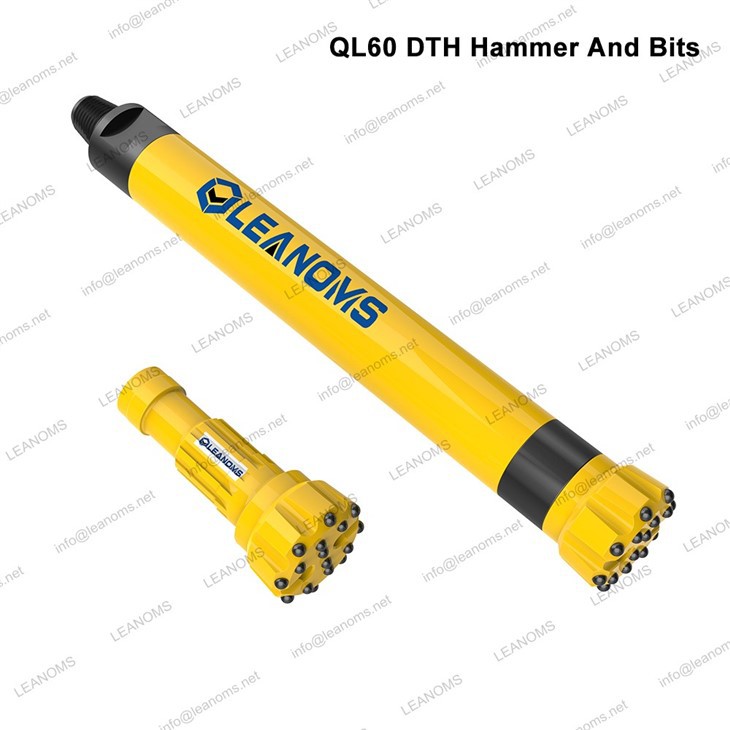
The QL60 DTH (Down-The-Hole) Bit is a specialized drilling tool used in large-scale mining and construction projects. It is designed with various faces to optimize drilling efficiency and performance in different rock formations. Here are the different faces commonly found in QL60 DTH Bits:
1. Concave Face: The concave face is the most common design for QL60 DTH Bits. It features a concave or curved surface on the front portion of the bit. The concave face design allows for optimal contact with the rock formation, promoting efficient energy transfer and rock breakage. It is well-suited for medium to hard rock formations.
2. Flat Face: Some QL60 DTH Bits are equipped with a flat face. The flat face design provides a larger surface area for contact with the rock, increasing stability and ensuring consistent drilling performance. It is commonly used in softer rock formations where efficient cuttings removal is essential.
3. Convex Face: The convex face design features a slightly rounded or convex shape. It is positioned towards the rear of the QL60 DTH Bit. The convex face helps maintain stability during drilling by evenly distributing the load across the bit face. It aids in preventing deviation and achieving straight drilling trajectories.
4. Domed Face: The domed face design is characterized by a smooth and rounded surface. It reduces friction between the bit and the rock formation, allowing for faster penetration rates and improved drilling efficiency. The domed face is particularly effective in abrasive rock formations.
5. Conical Face: Some QL60 DTH Bits feature a conical face design. This design includes a cone-shaped front portion that gradually tapers to a smaller diameter. The conical face helps with centering the bit during drilling and offers efficient energy transfer for effective rock breakage. It is commonly used in varying rock formations where versatility is required.
The choice of face design depends on the specific drilling requirements, including rock hardness, abrasiveness, and drilling conditions. QL60 DTH Bits may have a combination of faces to provide versatility and optimal drilling performance in various geological formations. These different face designs allow for efficient rock penetration, improved cutting action, and enhanced drilling productivity in large-scale mining and construction applications.
Specification LEANOMS
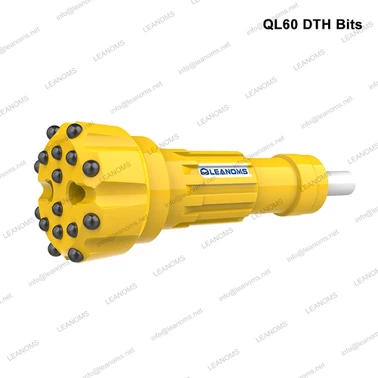
The QL60 DTH (Down-The-Hole) Bit, a specialized drilling tool used in large-scale mining and construction projects, is equipped with various buttons strategically placed on its face. These buttons, made of tungsten carbide, play a critical role in rock breaking and cutting action. Here are the different types of buttons commonly found in QL60 DTH Bits:
1. Dome Buttons: Dome buttons have a rounded shape, resembling a dome or a semi-sphere. They provide excellent wear resistance and impact strength, making them suitable for drilling in hard and abrasive rock formations. Dome buttons are known for their versatility and can handle a wide range of drilling conditions.
2. Ballistic Buttons: Ballistic buttons have a more conical shape, tapering to a point. They are designed to provide aggressive cutting action, making them effective in softer to medium-hard rock formations. Ballistic buttons are known for their high drilling speed and ability to maintain stable drilling trajectories.
3. Semi-Ballistic Buttons: Semi-ballistic buttons have a shape that falls between dome and ballistic buttons. They offer a balance between cutting efficiency and durability. Semi-ballistic buttons are commonly used in mixed rock formations where both hard and soft rock layers are encountered during drilling.
4. Parabolic Buttons: Parabolic buttons have a unique shape with a curved surface. They are optimized for self-sharpening, allowing for extended bit life and consistent performance. Parabolic buttons excel in medium to hard rock formations, offering excellent penetration rates and enhanced cutting efficiency.
5. Chisel Buttons: Chisel buttons have a flat and rectangular shape, resembling a chisel. They are primarily used for drilling in extremely hard and compact rock formations. Chisel buttons provide exceptional penetration capabilities and are effective in breaking through hard rock layers.
The distribution and arrangement of these buttons on the face of the QL60 DTH Bit can vary, depending on the specific drilling requirements and rock formations encountered. Different button combinations and layouts are employed to optimize the energy transfer, improve rock fragmentation, and ensure efficient drilling performance.
The selection of button types and configurations is crucial to maximize drilling efficiency, reduce bit wear, and achieve optimal productivity in large-scale mining and construction applications.


