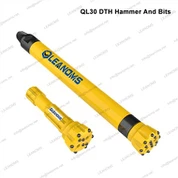
Products Description
LEANOMS
 Strict quality controlling:
Severe quality control;
Chosen, premium-grade specific steels and carbide;
QL40 DTH Bit produced by CNC equipment;
Low trouble rate, simple and sensible design;
Smooth drilling, high penetration rate, maximum impact power, and low air consumption.
Our QL40 DTH Bit is constructed from premium alloy steel and includes cutting-edge heat protection to guarantee excellent drilling performance and long service life. Our clients utilize them extensively all throughout the world. The QL40 DTH Bit comes in a variety of sizes and designs, and they work with a wide range of hammers, including those made by Ingersoll-Rand, Mission, Atlas Copco, and others. We provide flat face, concave, and drop center head designs for the most productive operation under diverse drilling situations.
Through this global support network, a complete range of world-class rock-drilling consumables, we design and customize highly technological tools to meet even the hardest of conditions, offering custom-made solutions for industries such as Mining, Oil & Gas, Geothermal, Quarries, Water well and Civil engineer drilling. LEANOMS has earned a reputation as the better choice of driller.
Company Profile
LEANOMS
Creative Research & Development:
Driver of innovation in the rock tools research and development is one of the essential elements included in LEANOMS's brand definition.
Consistent Quality Control:
Applied ISO 9001:2008 system ensures LEANOMS and its customers an efficient and reliable measurement of product quality control.
Superior Available Materials:
Only the Superior available raw material and service is offered to our customers from individual drilling operators to multinational corporations
Products Features
LEANOMS
Here are some general considerations for understanding the design differences between DTH bits:
Bit Face Design:
Different DTH bits may have variations in face design, including the arrangement, shape, and size of tungsten carbide buttons or inserts. The design of the cutting face influences drilling performance in different rock formations.
Bit Size and Weight:
The physical dimensions and weight of the DTH bit can impact its suitability for various drilling applications. Consider the size and weight specifications, as well as the intended use for the bit.
Number and Configuration of Buttons:
The number of tungsten carbide buttons and their configuration on the bit can vary. Some bits may have a higher number of smaller buttons, while others may feature larger buttons. The configuration can affect the bit's penetration rate and durability.
Bit Body Design:
The overall design of the bit body, including the shape and material, can influence the bit's strength, stability, and resistance to wear. Considerations such as the presence of waterways for cuttings removal and the design of the bit's center flushing can also differ.
Thread Type and Shank Design:
DTH bits are designed to be compatible with specific drilling rigs, hammers, and drilling systems. The thread type and shank design can vary between models, ensuring proper fit and compatibility with different equipment.
Materials and Heat Treatment:
Pay attention to the materials used in the construction of the DTH bit, particularly the quality of tungsten carbide inserts and the heat treatment processes employed. High-quality materials and precise heat treatment contribute to durability.
Special Features:
Some DTH bits may have special features designed for specific applications or challenging drilling conditions. These could include retractable pistons, enhanced flushing systems, or unique cutting structures.
failure analysis
LEANOMS
Tooth Loss:
In prolonged high-frequency vibrations or under high-impact loads, the tungsten carbide cutting components may dislodge, especially when dealing with hard rock formations.
Neck Fracture:
Under high-impact loads or design flaws, the connecting neck section may experience fractures, particularly when encountering obstacles during drilling.
Tungsten Carbide Failure:
Under extreme conditions such as high temperatures, high pressures, or unusually hard rock formations, the tungsten carbide cutting components may develop cracks, fractures, or wear.
Weld Seam Cracking:
Due to frequent impacts or vibrations, the welding seams of the DTH drill bit may develop cracks, leading to a failure in the welding joints and impacting the overall connectivity.
Key Damage:
In complex geological formations, the keys of the QL40 DTH Bit may undergo severe impacts, resulting in damage and diminishing the reliability of the connection.
Bearing Failure:
Under high-speed rotation and heavy load conditions, the bearing system of the QL40 DTH Bit may experience failure, leading to a decline in overall performance.
Sealing System Leakage:
Due to prolonged usage or harsh working environments, the sealing system may undergo wear or damage, causing lubricant and coolant leakage.
Overall Structural Fatigue:
Over extended periods of high-frequency vibrations and impacts, the overall structure of the DTH drill bit may undergo fatigue, resulting in a loss of strength and durability.
Products Specification
LEANOMS
Technical Parameters Of QL40 DTH Bits
| Diameter |
Gauge Buttons |
Front Buttons |
Weight(KG) |
Part Number |
||||
|
mm |
Inch |
Flat Face |
Convex Face |
Concave Face |
Face Type |
|||
|
115 |
4 1/2 |
Φ14*7 |
Φ14*2 |
Φ14*4 |
/ |
Convex Face |
9.6 |
LR-QL40-115CV-1 |
|
115 |
4 1/2 |
Φ16*7 |
Φ14*2 |
Φ14*4 |
/ |
Convex Face |
9.6 |
LR-QL40-115CV-2 |
|
115 |
4 1/2 |
Φ14*8 |
Φ14*2 |
Φ14*4 |
/ |
Convex Face |
9.6 |
LR-QL40-115CV-3 |
|
125 |
4 15/16 |
Φ14*8 |
Φ13*3 |
Φ14*4 |
/ |
Convex Face |
10.2 |
LR-QL40-125CV |
|
127 |
5 |
Φ14*8 |
Φ13*7 |
/ |
/ |
Flat Face |
10.3 |
LR-QL40127FF |
|
130 |
5 1/8 |
Φ14*8 |
Φ14*7 |
/ |
/ |
Flat Face |
10.5 |
LR-QL40-130FF |