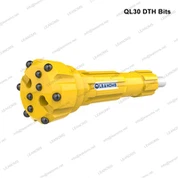
Products Description
LEANOMS
Down The Hole Bits are specialized tools used in the drilling industry, specifically in the field of mining, construction, and water well drilling. These bits are designed to create holes in various types of rock formations, typically for the purpose of extracting minerals, installing explosives, or installing wells.
Down The Hole Bits are used in a drilling technique known as down-the-hole drilling. In this method, a drill string with a hammer attached to the bottom is used to drive the bit into the rock formation. Compressed air or other fluids are used to power the hammer, which in turn strikes the bit, creating the necessary impact to break the rock.
Down The Hole Bits are typically made from high-quality steel and are available in various designs to suit different drilling conditions. They usually consist of a tungsten carbide button or insert that is brazed onto the bit's face. The shape and arrangement of these buttons or inserts can vary depending on the desired drilling application.
The selection of the appropriate Down The Hole Bits depends on factors such as the type of rock being drilled, the desired hole size, the drilling equipment being used, and the specific drilling objectives. Different bit designs and configurations are available to optimize performance and efficiency in different drilling scenarios.
Overall, Down The Hole Bits play a crucial role in the drilling process by providing the cutting and impact force necessary to create holes in rock formations efficiently and effectively.
Down-the-hole (DTH) drilling is a method used in mining and construction to penetrate rock formations. It involves a hammer-like mechanism that is connected to the bottom of a drill string, and the impact of the hammer on a drill bit creates fractures in the rock, allowing for drilling. There are several types of DTH bits available for different applications. Here are a few commonly used ones:
Button Bits: Button bits are the most widely used type of Down The Hole Bits. They have spherical tungsten carbide inserts (buttons) on the bit's face, which provide effective cutting and drilling action. Button bits are suitable for various formations, including soft to hard rocks and abrasive formations.

Convex Bits: Convex bits have a slightly convex face shape, which helps in maintaining good contact with the rock surface during drilling. This design feature enhances drilling performance and bit life, especially in fractured and abrasive formations.
Flat Face Bits: Flat face bits have a flat front face and are commonly used in harder formations. They provide good control over the hole diameter and are suitable for drilling in competent rock formations.
Concave Bits: Concave bits have a concave-shaped face, which helps in maintaining straighter holes. They are commonly used in softer formations, as the concave shape prevents the bit from deviating or wandering off the desired drilling path.
Chisel Bits: Chisel bits have a sharp, chisel-like shape with a narrow cutting edge. They are primarily used for drilling in extremely hard rock formations, such as granite or basalt.
Cross Bits: Cross bits have a cruciform shape with multiple cutting edges. They are primarily used for drilling in abrasive formations and are particularly effective in fractured rock.
Gauge Bits: Gauge bits have a larger diameter compared to the rest of the bit body, and they are used to maintain hole diameter and prevent excessive wear of the bit's outer edges. They are typically used in combination with other Down The Hole Bits types.
These are just a few examples of the types of Down The Hole Bits available. The choice of the bit depends on factors such as the type of rock formation, hardness, abrasiveness, and drilling requirements. It is important to select the appropriate bit for the specific drilling application to optimize performance and efficiency.
Specification
LEANOMS
Technical Parameters Of QL50 DTH Bits
|
Diameter |
Gauge Buttons |
Front Buttons |
Weight(KG) |
Part Number |
||||
|
mm |
Inch |
Flat Face |
Convex Face |
Concave Face |
Face Type |
|||
|
140 |
5 1/2 |
Φ18*7 |
Φ14*3 |
Φ15*4 |
/ |
Convex Face |
15.1 |
LR-QL50-140CV |
|
140 |
5 1/2 |
Φ16*8 |
Φ14*8 |
/ |
/ |
Flat Face |
15.3 |
LR-QL50-140FF |
|
146 |
5 3/4 |
Φ18*8 |
Φ15*8 |
/ |
/ |
Flat Face |
15.9 |
LR-QL50-146FF |
|
146 |
5 3/4 |
Φ18*8 |
Φ15*4 |
/ |
Φ14*3 |
Concave Face |
15.8 |
LR-QL50-146CC |
|
152 |
6 |
Φ18*8 |
Φ15*8 |
/ |
/ |
Flat Face |
16.4 |
LR-QL50-152FF |
|
152 |
6 |
Φ18*8 |
Φ16*4 |
/ |
Φ14*4 |
Concave Face |
16.2 |
LR-QL50-152CC |