


How is the DTH Bit formed and What are Structural Characteristics of the DTH Bit?
Main Form Process
DTH (Down-The-Hole) bits are made by forging the steel body, then machining and grinding to create the desired shape and cutting edge, and finally, attaching tungsten carbide buttons to improve durability and cutting performance.
 Forging the Steel Body
The formation of DTH bit begins with the forging of a high-quality alloy steel into the basic shape of the DTH bit. That is to say, the steel is first forged to create a rough DTH bit.
Forge is defined as heating up by hammering or squeezing. During forging, the metal is made plastic by heating and then deformed by hammering during heating.This process is usually carried out above the recrystallization temperature.
Forging not only shapes the material but also enhances its internal structure, making it more robust and resilient.
Heat Treatment
Heat treatment is a key step in the production of DTH bit. It involves heating the bits to very high temperatures and then cooling them quickly. This process, known as quenching.
The DTH bit, through proper heat treatment, ensures that the bit can withstand the high impact and abrasive conditions encountered during drilling. At the same time, the heat treatment also extends the service life of DTH bits, making them more cost-effective for the end user.
Annealing
After forging and heat treatment, annealing begins. Annealing generally refers to any heating and cooling operation commonly used to induce softening. After annealing, the metal becomes soft and easy to process. And then sent for further processing.
Machining and Grinding
The forged body is then machined to create precise shapes and grooves, which aid in debris removal and efficient drilling. Then grinding sharpens the tip and creates the desired cutting angles.
Attaching Tungsten Carbide Buttons
Tungsten carbide buttons, known for their hardness and durability. Therefore, it is attached to the surface of the DTH bit to provide cutting effect. These buttons are arranged in a specific pattern to ensure efficient rock breaking.
Surface Treatment and Coating
In order to reduce friction, resist corrosion, and increase the wear resistance of the DTH bit, surface treatments and coatings can be used. These treatments are designed to Common treatment methods include carburizing, nitriding and the application of special coatings such as tungsten carbide.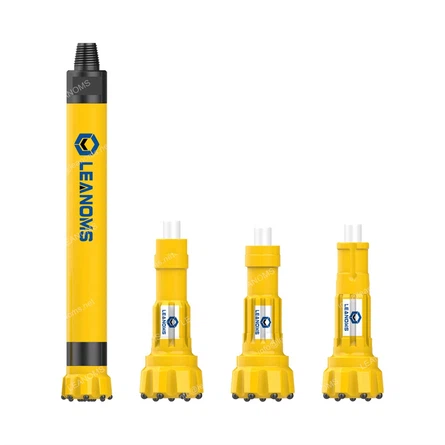
Structural Characteristics
Robust Construction
DTH bits are built to withstand the harsh conditions of rock drilling by using high-grade alloy steel and tungsten carbide buttons.So the durability of DTH bit is good.
Deep Face Grooves
These grooves design of DTH bits facilitate efficient flushing of drill cuttings, keeping the hole clean and preventing premature bit wear.
Aggressive Cutting Structure
The design of the DTH bit promotes rapid penetration and efficient rock removal.
Variety of Designs:
Different DTH bit designs cater to various rock types and drilling conditions, including concave, convex, flat-face bits,ballistic buttons, flat buttons, spherical buttons and so on.
Customizable
The DTH bit can be customized to meet specific drilling needs for optimal performance in a variety of applications.
Wide application
DTH bits are used in various applications, including surface mining, quarries, construction projects, water well drilling and so on.
Efficient
DTH bits are designed to improve drilling efficiency by utilizing advanced flow simulations to drive designs that enhance chip removal.
