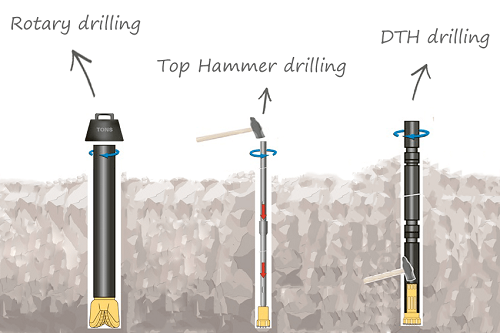
DTH (Down-The-Hole) drilling and rotary drilling are two common methods used in the drilling industry, each with its unique characteristics and applications. Here are the key differences between DTH and rotary drilling:
1. Drilling Mechanism:
DTH Drilling (Down-The-Hole):
Mechanism: DTH drilling involves a hammer fitted with a drill bit that strikes the rock at the bottom of the hole. Compressed air is used to drive the hammer and remove cuttings from the hole.
Application: DTH drilling is highly effective in hard rock formations and is commonly used in mining, quarrying, construction, and water well drilling.
Rotary Drilling:
Mechanism: Rotary drilling involves a rotating drill bit attached to the end of a drill string. The drill bit grinds and cuts the rock as it rotates, and mud or other drilling fluids are circulated down the drill pipe to flush out cuttings and cool the bit.
Application: Rotary drilling is versatile and used in various geological formations, including soft soils, clays, sands, and rocks. It is commonly used in geotechnical investigations, oil and gas exploration, and water well drilling.
2. Drilling Speed and Penetration:
DTH Drilling:
DTH drilling tends to offer higher penetration rates in hard rock formations due to the hammer impact, which breaks the rock effectively.
It is particularly suitable for applications where drilling speed and penetration are crucial, such as in mining for ore extraction.
Rotary Drilling:
Rotary drilling can be slower in hard rock compared to DTH drilling because it relies on the bit's grinding action rather than impact to break the rock.
However, rotary drilling is generally faster in softer formations and is often chosen for its versatility in handling various ground conditions.
3. Drilling Depth:
DTH Drilling:
DTH drilling is effective at shallow to medium depths, especially in hard rock formations.
It may encounter challenges in deeper drilling due to the limitations of hammer efficiency and the removal of cuttings.
Rotary Drilling:
Rotary drilling methods, such as mud rotary or air rotary, are capable of drilling to much greater depths.
They are commonly used in deep borehole drilling for geothermal wells, oil and gas exploration, and water wells.
4. Hole Diameter:
DTH Drilling:
DTH drilling can create relatively small-diameter holes, making it suitable for applications where precision is required.
Rotary Drilling:
Rotary drilling methods can create a wide range of hole diameters, from small exploratory holes to large-diameter foundation piles.
Both DTH and rotary drilling methods have their advantages and are chosen based on the specific geological conditions, required hole diameter, drilling depth, and project objectives. The choice between the two methods depends on the project's unique requirements and the expertise of the drilling professionals involved.