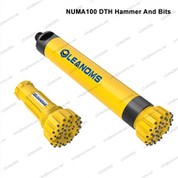
Products Description LEANOMS
The Hammer DTH (Down-The-Hole) refers to a drilling technique and equipment commonly used in mining and construction industries. It involves using a pneumatic hammer that is driven downward to create holes in various materials such as rock, soil, and concrete. The Hammer DTH operates by delivering rapid and powerful blows to the drilling bit, which in turn pulverizes the material and enables efficient drilling. This technique is widely favored for its speed, precision, and effectiveness in various drilling applications.
The production process of a Hammer Down-the-Hole (DTH) involves several key steps:

Design and Engineering: The first step is to design the DTH hammer, considering factors such as drilling depth, rock hardness, and desired performance. Engineering teams create detailed specifications and drawings.
Material Selection: High-quality materials, such as alloy steel, are chosen for manufacturing the Hammer DTH body and components. These materials should have excellent strength, durability, and resistance to wear and corrosion.
Machining: The manufacturing process begins with machining the hammer body and other components. Advanced machining techniques, such as CNC (Computer Numerical Control) machining, are employed to ensure precision and consistency.
Heat Treatment: The machined parts undergo heat treatment to enhance their mechanical properties. Heat treatment processes like quenching and tempering are applied to improve hardness, toughness, and resistance to deformation.
Assembly: The various components, including the hammer body, piston, bit, and valve system, are assembled. Careful attention is given to proper alignment and fit to ensure optimal performance.
Quality Control: Rigorous quality control measures are implemented throughout the production process. Inspections and tests, such as dimensional checks, hardness testing, and pressure testing, are conducted to ensure that the Hammer DTH meets the required specifications and performance standards.

Surface Treatment: The hammer undergoes surface treatment processes, such as coating or plating, to provide additional protection against wear, corrosion, and friction. Common surface treatments include chrome plating or applying specialized coatings.
Final Inspection and Packaging: The completed Hammer DTH undergoes a final inspection to verify its quality and performance. It is then carefully packaged, often with protective materials, to prevent damage during transportation and storage.
Distribution: The finished Hammer DTH is shipped to distributors, drilling equipment manufacturers, or directly to end-users who require these tools for various drilling applications.
It's important to note that the specific production process may vary slightly depending on the manufacturer and the design of the Hammer DTH.
Specification LEANOMS
Technical Parameters Of NUMA125 DTH Bits
| Diameter | Gauge Buttons (mm) |
Front Buttons(mm) | Weight(KG) | Part Number | ||||
| mm | Inch | Flat Face | Convex Face | Concave Face | Face Type | |||
| 305 | 12 | Φ18*27 | Φ18*15 | / | Φ16*11 | Concave Face | 182.0 | LR-N125-305CC |
| 315 | 12 2/5 | Φ18*27 | Φ18*15 | / | Φ16*12 | Concave Face | 206.0 | LR-N125-315CC |
| 325 | 12 4/5 | Φ18*27 | Φ18*15 | / | Φ16*15 | Concave Face | 209.0 | LR-N125-325CC |
| 350 | 13 7/9 | Φ18*27 | Φ18*24 | / | Φ16*12 | Concave Face | 228.0 | LR-N125-350CC |