


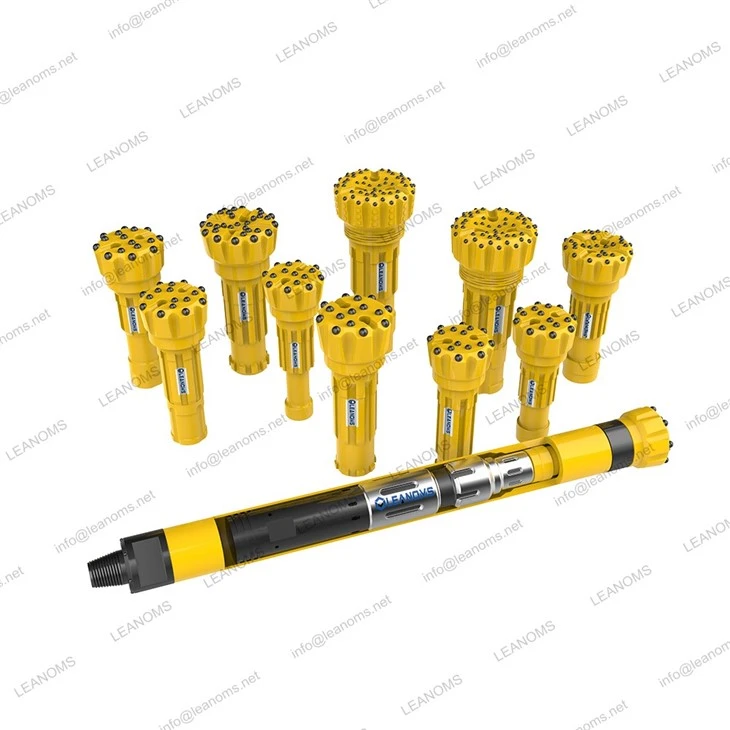

Products Description LEANOMS
A 3.5 inch DTH Hammer refers to a drilling tool commonly used in the mining, construction, and oil and gas industries for drilling holes in hard rock, earth, and other materials. The term "3.5-inch" refers to the diameter of the hammer itself, which is the size of the bit that strikes the rock or material being drilled. DTH hammers are an integral part of the DTH drilling process, which is a percussion drilling technique that involves hammering a drill bit into the rock while simultaneously rotating the bit.
Here's how a 3.5 inch DTH Hammer works:
Hammer Body: The 3.5 inch DTH Hammer is a cylindrical device that houses a piston or hammer that's free to move within the chamber. Compressed air or other drilling fluids are used to operate the hammer.
Drill Bit: Attached to the bottom of the hammer is a drill bit, which is responsible for breaking and chipping away the rock or material. The size of the bit corresponds to the diameter of the hole you want to drill.

Air Supply: Compressed air is forced down the drill pipe and into the hammer. This air pressure pushes the piston or hammer in the chamber upwards.
Valve Mechanism: When the hammer reaches the top of its stroke, it opens a valve that allows the high-pressure air to escape into the hammer's piston chamber. This creates a sudden impact force that's transmitted to the drill bit.
Impact Force: The impact force generated by the sudden release of air pressure causes the drill bit to strike the rock or material at the bottom of the hole. This impact breaks the rock into smaller pieces.
Rotation: Simultaneously, the drill string is rotated, which helps to maintain the direction of the hole and aids in the drilling process.
Cuttings Removal: The broken rock pieces (cuttings) are flushed out of the hole by the drilling fluid, typically air or water, which is continuously pumped down the drill string.
Repeat: The process of impact, rotation, and cuttings removal is repeated until the desired depth is achieved.
DTH drilling is known for its efficiency and suitability for hard rock drilling, making it a preferred choice in various industries. The choice of hammer size depends on the drilling requirements, the hardness of the rock, and the depth of the hole needed. In the case of a 3.5 inch DTH Hammer, it would be appropriate for drilling holes with a diameter of approximately 3.5 inches.
Specification LEANOMS


