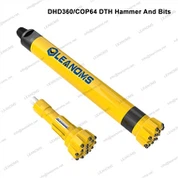
Products Description LEANOMS
The Low Pressure DTH Hammer is an innovative drilling tool designed for various industries such as mining, construction, and exploration. It offers several features and advantages that make it a preferred choice for many drilling applications. Here are some of its key features and advantages:
1. Efficient Energy Transmission: The Low Pressure DTH Hammer utilizes a unique design that optimizes energy transmission from the drill rig to the drill bit. This efficient energy transfer results in faster drilling and increased productivity.
2. Low Pressure Operation: As the name suggests, this hammer operates at low pressure, typically below 10 bar. This low-pressure operation reduces wear and tear on the hammer components, leading to longer service life and lower maintenance costs.
3. Reduced Air Consumption: Compared to traditional DTH hammers, the Low Pressure DTH Hammer consumes less compressed air during operation. This feature not only improves drilling efficiency but also reduces the overall energy consumption, resulting in cost savings for the drilling project.
4. Versatility: The Low Pressure DTH Hammer is suitable for drilling in a wide range of formations, including hard rock, fractured rock, and abrasive formations. Its versatile design allows it to adapt to various drilling conditions and deliver consistent performance across different applications.
5. Improved Penetration Rate: The efficient energy transmission and low-pressure operation of the hammer contribute to a higher penetration rate. It allows the drill bit to cut through the rock faster, reducing drilling time and increasing productivity on the worksite.
6. Precise Hole Straightness: With its advanced design and stable operation, the Low Pressure DTH Hammer enables precise drilling and maintains hole straightness. This feature is crucial in applications that require accurate hole alignment, such as foundation piling and geotechnical drilling.
7. Enhanced Safety: The Low Pressure DTH Hammer incorporates safety features to ensure smooth and secure drilling operations. It is designed to minimize the risk of accidents, such as blowouts or sudden pressure releases, ensuring the safety of the drilling crew and equipment.
8. Cost-Effective Solution: The combination of improved drilling efficiency, reduced maintenance costs, and lower energy consumption makes the Low Pressure DTH Hammer a cost-effective drilling solution. It helps project owners and drilling contractors optimize their operational expenses and achieve better financial outcomes.
In summary, the Low Pressure DTH Hammer offers efficient energy transmission, low-pressure operation, reduced air consumption, versatility, improved penetration rate, precise hole straightness, enhanced safety, and cost-effectiveness. These features and advantages make it a valuable tool for a wide range of drilling applications, enabling faster, safer, and more economical drilling operations.

Specification LEANOMS
The Low Pressure DTH Hammer finds applications in various industries where drilling is required. Its versatility and efficient performance make it suitable for different drilling applications. Here are some of the key applications and customer groups that benefit from the use of the Low Pressure DTH Hammer:
1. Mining: The mining industry extensively uses the Low Pressure DTH Hammer for exploration and production drilling. It is suitable for drilling blast holes, extracting core samples, and conducting geological surveys in both surface and underground mining operations. The hammer's ability to handle different rock formations makes it a valuable tool in various mining applications.
2. Construction: In the construction industry, the Low Pressure DTH Hammer is commonly employed for foundation drilling, piling, and anchoring. It is used to create holes for building supports, infrastructure development, and construction projects that require reliable and precise drilling.
3. Geotechnical Engineering: Geotechnical drilling involves studying the subsurface conditions to assess soil and rock properties. The Low Pressure DTH Hammer is used in geotechnical drilling applications to collect soil and rock samples, conduct in-situ testing, and install instrumentation for monitoring purposes. Its accurate hole straightness and efficient penetration rate are beneficial in geotechnical investigations.
4. Water Well Drilling: The Low Pressure DTH Hammer is utilized in water well drilling operations, whether it's for domestic, industrial, or agricultural purposes. It helps create boreholes for accessing underground water sources, ensuring efficient and reliable water supply for various applications.
5. Exploration: In the field of exploration drilling, the Low Pressure DTH Hammer is utilized for mineral exploration, oil and gas exploration, and environmental sampling. Its ability to handle different rock types and provide accurate core samples is instrumental in assessing the potential of natural resources and understanding the subsurface composition.
6. Civil Engineering: Civil engineering projects often require drilling for soil investigation, soil stabilization, and slope stabilization. The Low Pressure DTH Hammer is used in civil engineering applications to gather soil samples, conduct tests, and install anchors or grouting elements to reinforce the ground.
The customer groups that benefit from the Low Pressure DTH Hammer include mining companies, construction firms, drilling contractors, geotechnical engineering firms, water well drilling companies, exploration companies, and civil engineering organizations. These customer groups rely on the hammer's performance, efficiency, and versatility to carry out their drilling operations effectively and achieve their project objectives.
Overall, the Low Pressure DTH Hammer caters to a wide range of drilling applications and serves diverse customer groups involved in mining, construction, geotechnical engineering, water well drilling, exploration, and civil engineering. Its adaptability, reliability, and efficiency make it a valuable tool for professionals in these industries.