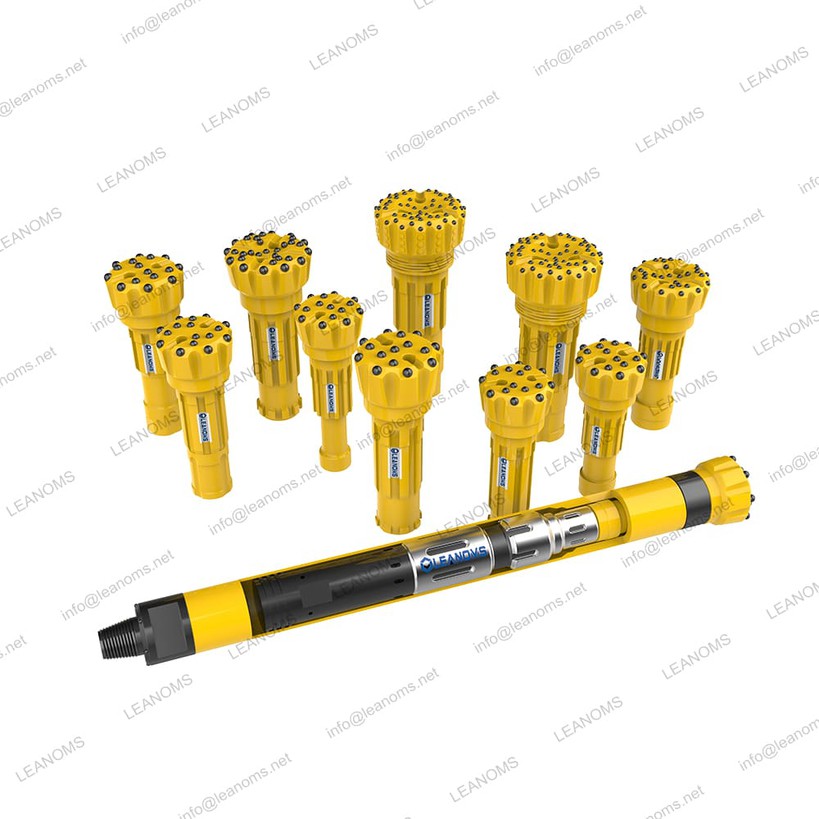
WHAT IS DTH Hammer?
The DTH Hammer is connected to the lower end of the DTH drilling pipe, and the drill rig drives the drill pipe to rotate. Compressed air (compressed air) enters the DTH Hammers through the DTH drill pipe to produce a certain frequency of impact force to break the rock. At the same time, the exhaust gas is used to attack the hammer The bit (DTH drill bit) cools and discharges the chiseled cuttings out of the hole. Because the outer diameter of the DTH Hammer is smaller than the diameter of the hole, it can be lowered into the hole as the drilling depth increases (the name of the DTH Hammer comes from this). Compared with the pneumatic drill that impacts outside the hole, its impact energy loss is small, and it can drill deeper holes.
Scope of application:
This method is suitable for drilling into hard rock formations, the drilling is not easy to deviate, and it is more advantageous to use in water-deficient areas. Using it to drill into hard rock and pebble layers, the drilling efficiency can be increased several to ten times compared with conventional rotary drilling and mechanical impact drilling, and it has been promoted as advanced technology. Its application fields have been expanding. In the past, it was mainly used for drilling blast holes in mines, but it has been applied in hydropower, railways, highways, water wells, building foundation piles, and geological prospecting.
Components of a DTH Hammer:
Top Sub:
The top sub is the uppermost part of the DTH hammer, and it provides a connection point for the drill string. It typically includes a threaded connection for attaching to the drill pipe.
Cylinder:
The cylinder houses the piston and provides a chamber for the compressed air to act upon the piston, generating the necessary impact energy.
Piston:
The piston is a critical component that moves within the cylinder. It is powered by compressed air, and its movement creates a powerful impact force that is transmitted to the drill bit.
Valve:
DTH hammers often feature a valve system that controls the flow of compressed air and directs it to the piston during the drilling process. The valve system plays a key role in the efficiency of the hammer.
Air Channels:
The DTH hammer has air channels that facilitate the flow of compressed air from the surface through the drill string to the hammer. These channels are designed to optimize air delivery to the piston for maximum impact.
Bit Retaining System:
The bit retaining system secures the drill bit in place at the bottom of the DTH hammer. It allows for easy removal and replacement of the drill bit when needed.
External Casing:
The external casing of the DTH hammer provides structural support and protection for internal components. It is designed to withstand the forces and impacts encountered during drilling.