


How to Protect Drill Bit from Bit Head - Steel Damages?
It is well known that before starting a project, everyone should know more about the hardness and abrasiveness of the local rock. It is especially important to choose the right drill bit to match the rock conditions. Pay attention on overdrilled gauge button, which is mainly cause of drill bit head - steel damages. Remedies: Shorten grinding intervals and take out the bit for regrinding when the wear diameter is 1/2 of the button diameter.
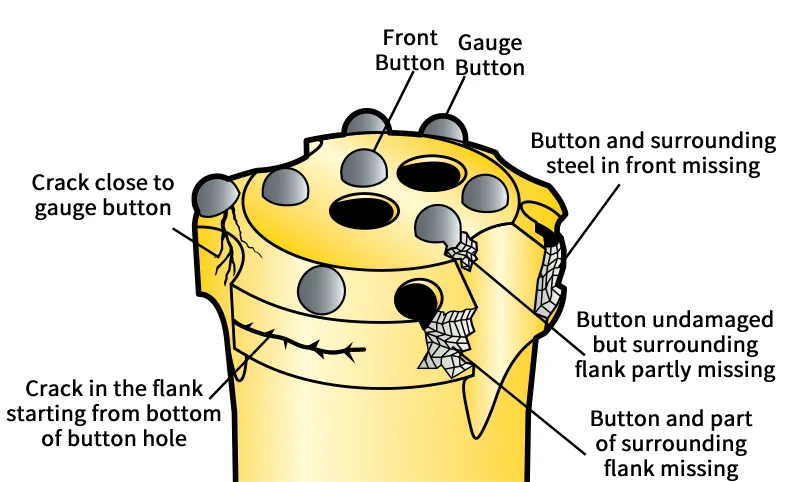
| Description | Cause | Remedy |
| Crack close to gauge button | • Overdrilled Gauge Button | • Shorten grinding intervals • Take out the bit for regrinding when the wear diameter is 1/2 of the button diameter |
| Crack in the flank starting from bottom of button hole | • Overdrilled gauge button. Repeated overdrilling, which causes excessive wear of bit head diameter | • Shorten grinding intervals and make sure that the clearance angle is correct • Take out the bit for regrinding when the wear diameter is 1/2 of the button diameter |
| Button undamaged but surrounding flank partly missing | • Damage caused by external object | • Avoid drilling into ground support, e.g. roof bolts |
Button and part of surrounding flank missing | • Diameter too small in combination with overdrilling of Gauge Button | • Shorten grinding intervals and make sure that the clearance angle is correct • Take out the bit for regrinding when the wear diameter is 1/2 of the button diameter • Check the bit diameter |
Button and surrounding steel in front missing | • Steel fatigue | • Shorten grinding intervals and make sure that the clearance angle is correct • Take out the bit for regrinding when the wear diameter is 1/2 of the button diameter • Increase feed force |
| Excessive steel wear of bit face | • Steel wear, due to abrasive rock condition, causing button protrusion | • Grind buttons to the proper protrusion |
| • Bit unsuitable for the rock formation | • Change to a more suitable bit |
