


Drilling is an important working method in geological exploration and the most important means to obtain underground rock and mineral layer data. In many geological exploration projects, drilling work takes up a lot of manpower, material and financial resources, and its quality and efficiency directly affect the quality of geological reports and exploration costs.
1. Diamond Drill bit selection
When using a rope drill, you must first select a diamond drill bit that is suitable for the formation. It requires the drill bit to not only have high time efficiency and be easy to break rocks but also have a long service life. If the drill bit has a low time efficiency, it will directly affect the drilling efficiency. If the drill bit has a short life, the drill bit must be frequently replaced, which will reduce the drilling efficiency and increase the cost, and the advantages of the rope drill cannot be fully utilized. Therefore, it is necessary to select a good drill bit based on the physical and mechanical properties of the rock, including the rock's drillability, hardness, strength, abrasiveness and integrity, while also considering the economic benefits and the actual situation of the construction team. The selection includes the particle size, strength and concentration of the diamond, the matrix performance of the Diamond Core Drill bit, the type of inlay, the drill bit nozzle, etc.
1.1 Selection of diamond particle size, strength and concentration
When selecting diamond, the drilling speed is generally considered first, followed by the life of the drill bit; in hard, brittle and broken formations, the life of the Diamond Core Drill bit should be given priority; in hard and dense formations, the drilling speed and the life of the drill bit should be considered simultaneously.
1.1.1 Drilling in relatively complete medium-hard and lower rock formations
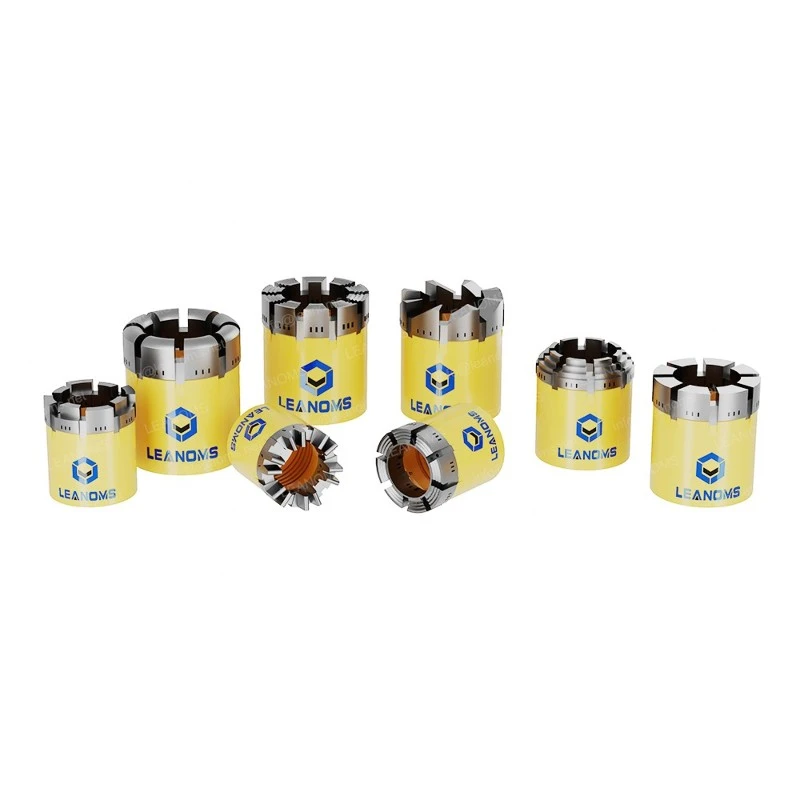
Particle size selection: Because the rock has a weaker wear on diamonds, the pressure applied to a single diamond does not need to be very large to carve the rock in the form of volume crushing, so diamonds are not easy to break. Coarser diamonds should be selected to obtain both higher drilling speed and drill bit life.
Strength selection: Because the rock has a low compressive strength, a higher drilling speed can be obtained with a smaller drilling pressure, and lower strength diamonds can be selected.
Concentration selection: The life of the drill bit is generally higher, and the drilling speed is particularly important, so the diamond concentration should not be too high.
1.1.2 Drilling into hard, dense, hard, brittle, and broken formations
Grain size selection: Diamonds not only withstand large axial pressure and shear force, but also withstand large impact force. Finer grain diamonds must be selected to extend the life of the drill bit.
Strength selection: Diamonds not only withstand large axial pressure and shear force, but also withstand large impact force. Finer grain diamonds must be selected to extend the life of the drill bit.
Concentration selection: In order to extend the life of the drill bit and increase the drilling speed, higher strength diamonds must be selected.
 1.2 Selection of matrix performance
The wear resistance of the matrix is one of the important factors affecting the life of the Diamond Core Drill bit. The wear resistance of the matrix should be adapted to the abrasiveness of the rock being drilled, that is, the bottom rock and abrasive particles should moderately wear the matrix metal while drilling, so that the diamonds in the matrix can maintain a good edge state. There are many factors that affect the wear resistance of the matrix, such as the composition of the matrix alloy and its own hardness, the concentration of diamonds in the matrix, and the wear state of the bottom of the hole during drilling. It is very important to choose a matrix suitable for the rock. The wear resistance of the matrix of a drill bit is only suitable for certain formations. A drill bit that is suitable for intact formations below medium hardness will show insufficient wear resistance and excessive wear when drilling in highly abrasive and broken formations, causing the diamonds to break and thresh.
The diamond fragments and highly abrasive rock powder that fall down form a three-body abrasive wear with the drill bit and the rock under the rotary pressure of the drill bit, which accelerates the wear of the matrix and intensifies the threshing of diamonds on the Diamond Drill bit, seriously shortening the service life of the drill bit. However, drill bits with high matrix hardness have poor self-sharpening and low drilling efficiency when drilling in medium-hard or lower formations. When encountering hard and weakly abrasive formations (commonly known as "slippery" formations), if the matrix hardness is too high, the diamond concentration is too high, and the particle size is too fine, the matrix is not easy to wear and the diamond is not easy to expose, which affects the drilling efficiency; on the contrary, if the matrix hardness is too low, although the diamond is easier to expose and carve rocks, the matrix wears too quickly and affects the life of the drill bit. It can be seen that if the matrix hardness is too high or too low, the drill lifting interval will be shortened due to the replacement of the drill bit.
